Showing posts with label biology. Show all posts

Monday, May 8, 2017

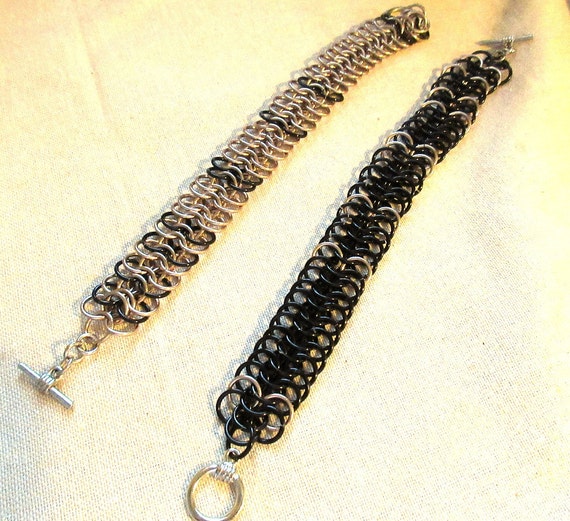
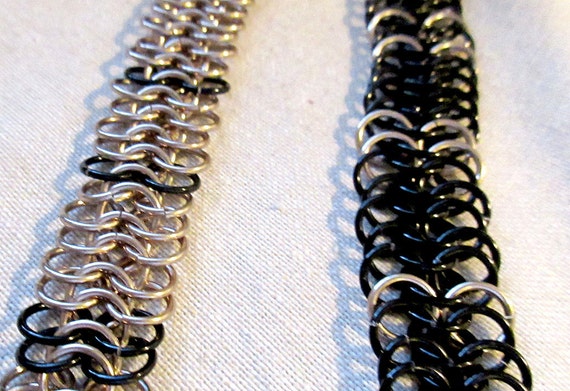
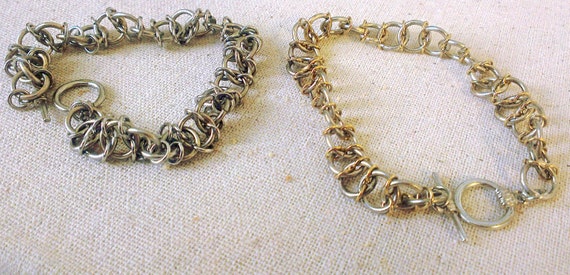
Newly Relisted: Gel Electrophoresis Chainmaille Bracelets

Guys, I am so damn proud of these bracelets. I spent years thinking about how to incorporate chainmaille into my work, until I hit upon the idea of gel electrophoresis art. Then, I probably spent another couple of months thinking about how I could pull it off. I finally debuted these puppies during this year's SciArt Tweetstorm, after some valuable input from Peggy over at The Vexed Muddler.

Biology has always been a field that I've had to neglect. The nature of the work is not something easily encapsulated by simple bead-stringing; chainmaille finally allowed me to represent images instead of numbers. I was, and still am, excited about taking my jewelry in this direction.

You can imagine, then, that it's breaking my heart a little that they're not selling, but I have no one but myself to blame for that. I picked the wrong time of year to stop promoting my shop -- the triple whammy of Pi Day, Mother's Day and graduation events within a three-month period means that this is exactly the time of year for nerdy bespoke jewelry to be popular, right? Usually, yes. This year I dropped off the map.

That's a long way to say that these bracelets deserve better than me. More promotion, a sexed-up photograph, some clever copy . . . all three? But there's only so many balls a person can juggle.

Biology science sciart gel electrophoresis art bracelet chainmalle jewelry
1kb Step Ladder Gel Electrophoresis Bracelet by Kokoba Jewelry

I love bead-stringing, and I always will, because I am a sucker for pretty rocks. But there is a Zen-like simplicity in chainmaille. No knots, no crimps, no string or wire: just you, two pliers, and a bunch of jump rings. It's a lot easier to pick up and put down, which is something I need at this point in my life.

Biology science sciart gel electrophoresis art bracelet chainmalle jewelry

Right now I only have these two colors (black and a silvery champagne). Once I recover from the hit that is tax season in two different countries, I'm going to put in an order for more. I have visions of rainbow pride versions of these, for the LGBTQ+ scientists and allies in the field, but that might have to remain a pipe dream for the time being. I don't think I could get more than a couple out in time for actual Pride this year.

Monday, January 23, 2017

Newly Listed: DNA Chainmaille Earrings

I am team No Piercings, which means that 90% of the time I completely neglect making earrings, and then 10% of the time I remember that other people have holes in their ears and binge-make a whole bunch. (Of earrings, not ears.) Here are the goodies from my latest binge: chainmaille DNA earrings.

Biology sciart science jewelry double helix DNA earrings
Chainmaille DNA earrings by Kokoba


I use two different weaves that resemble DNA's double helix spiral: This is Not Food and Inverted Spiral. (I also want to be very clear: these weaves are not my creation!) These earrings are an example of This is Not Food.

Biology sciart science jewelry double helix DNA earrings

The jump rings and the ear wire are both base metal (an alloy of copper, nickel, and zinc). I'm not comfortable enough with maille to pull out the big precious metal guns, but one day! However, these and all of my earrings can be set on sterling silver ear wire for those of you with sensitive skin or nickel allergies. 

Thursday, December 22, 2016

#TBT Electron Mass Necklace

This is a Kokoba beta release. It was originally an item for the Mad Scientists of Etsy!'s monthly challenge at some point in 2013: an item inspired by the discovery of a new species of frog that is the world's smallest vertebrate.

Image courtesy Christopher Austin, LSU
I'm still quite pleased with how it came out.

Quantum physics sciart science necklace
Electron radius necklace by Kokoba Jewelry
I tried to stick with frog-y colors, and the green aventurine beads you see there are 8 mm in diameter: around the same size of Paedophryne amauensis (which is technically an average of 7.7 mm in length). And since we're talking about something really, really small, what better way to celebrate it than with a subatomic particle?

Monday, November 28, 2016

Newly Listed: Copper DNA Chainmaille Bracelet

I can't stop playing with this inverted spiral weave. The shape is just such a great way to represent DNA's double helix structure. It's addictive and gorgeous!

DNA sciart chainmaille biologist bracelet biology jewelry
Copper and aluminum DNA chainmaille bracelet by Kokoba
After I put out a few two-tone DNA necklaces and bracelets, I felt comfortable enough with the weave to try a monochrome version. (The nature of things is that this weave can be a little confusing at first, so using two different colors makes i easier to keep track of things.) I had some extra copper rings on hand, so I decided to see what I could make out of them.

DNA sciart chainmaille biologist bracelet biology jewelry

I didn't have enough for a full bracelet, but I had plenty of other rings to finish it off. I actually really like the "focal point" look of the spiral weave and then just a plain, utilitarian one for the rest of the bracelet.

DNA sciart chainmaille biologist bracelet biology jewelry


I think I also like how the spiral weave looks in rings in a slightly heavier gauge. (Or, to be more precise, with a slightly smaller aspect ratio.) The weave is a little tighter and feels a little more solid. I think the lines of the spiral also show up a bit cleaner as well.

DNA sciart chainmaille biologist bracelet biology jewelry

I think I have well and fully mastered this weave. Next on my list is Persian 3-in-1 (I have really exciting ideas about what to do with sheets of it) but it is tricky as hell to pick up and the urge to mindlessly crank out something I know can do is strong. I guess it's also good stress relief; there is something meditative about chainmaille that beading lacks. 

Monday, October 31, 2016

Newly Listed: DNA Chainmaille Necklace

Last week I outlined the trials and tribulations of finding a way of capturing the infamous double helix spiral in jewelry. (Short of full-on casting or 3D printing, processes I am literally and metaphorically not equipped to take on.) I would like to present to you the proper, right-handed companion piece to that bracelet: this DNA necklace.

Sciart biology genetics jewelry DNA double helix necklace
DNA Chainmaille Necklace by Kokoba

Friday, October 28, 2016

Friday Find: Woolly Bear Affair

I've been enjoying having Friday 5 to do—it's nice to have someone else think of topics to write about once a week!—but the site I usually use is down and 5 Fandom Friday seems to be as dead as disco so I'm excited to bring back the ol' Friday Find and share with you: Woolly Bear Affair!

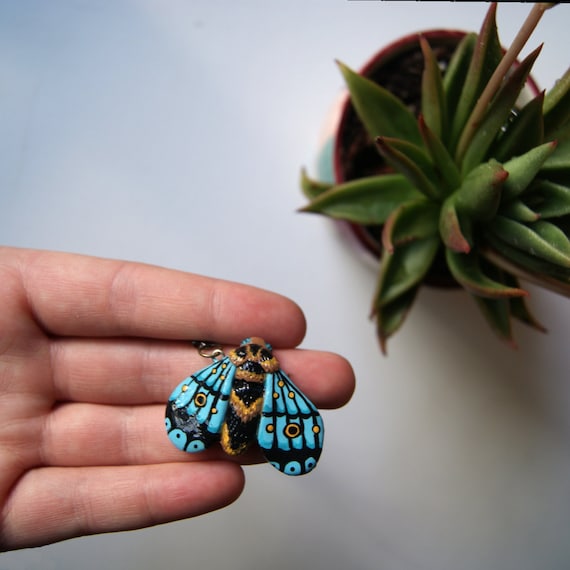
Billing her shop as cruelty-free bug collecting, Annie Konarska makes freaking ADORABLE clay bugs. Some of them are wearable, like this eye-catching moth:

Teal moth entomology bug jewelry necklace
Teal Moth Necklace by Woolly Bear Affair

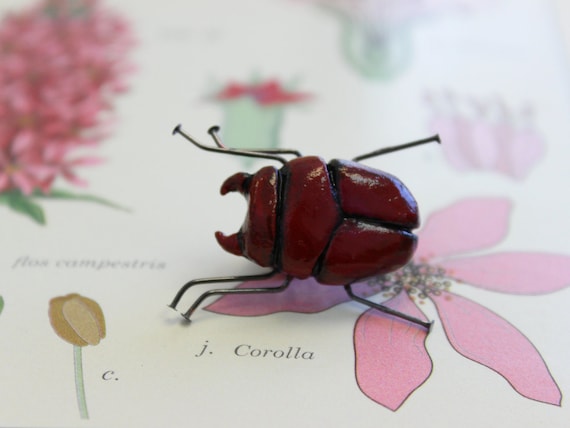
Or this red beetle brooch:

Entomology sciart jewelry red beetle bug brooch
Red Beetle Brooch by Woolly Bear Affair


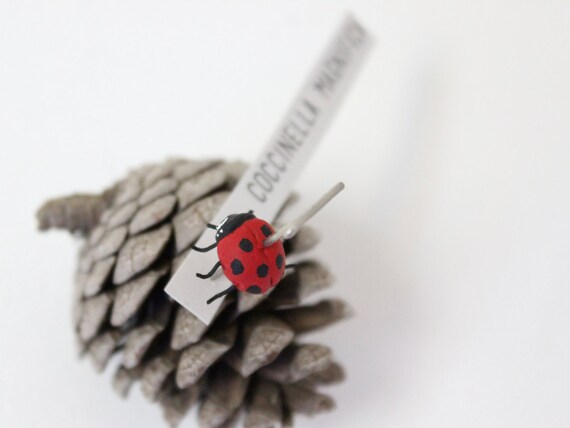
Others are actually collectible little specimens, complete with pin and name tag!

Entomology cute polymer ladybug bug collection
Ladybug by Woolly Bear Affair

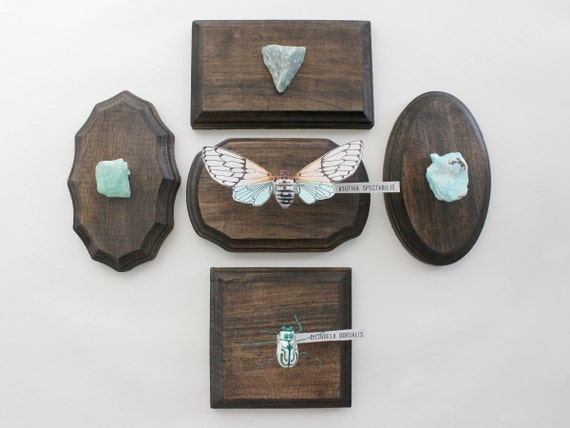
If you want to get extra fancy, there are also display mounts:

Display Mount by Woolly Bear Affair


This bug's for you, entomologists!

Monday, October 24, 2016

Newly Listed: DNA Chainmaille Bracelet

From the very beginning of my jewelry...line, I guess?...I knew I wanted to do something with the infamous double helix structure of DNA:


But how to do it? It took years of selling and digging around on the Internet, but I think I've finally figured it out! So, to celebrate my latest and greatest , let's review my brief and inglorious history with the double helix.

1. I made one sad attempt at wire earrings and they were actually my first sale on Etsy—mortifying. I try not to remember that too often, and I hope that customer is still happy with them.

Not pictured because UGH EMBARRASSING.

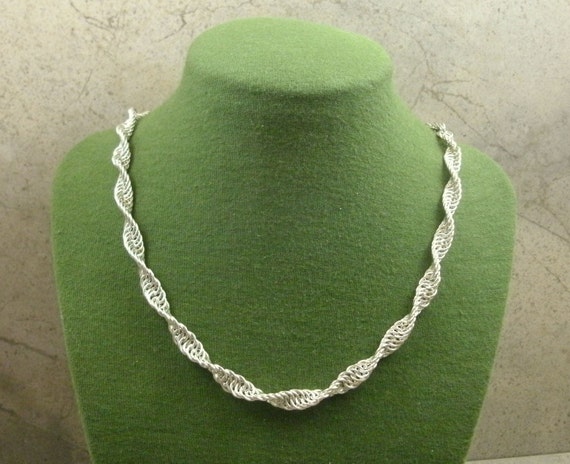
2. Years later I learned that chainmaille was a thing, and that there were spiral weaves. The prettiest one I found at first was the serpentine weave, also known as spiral 4-in-1 or just spiral. Here it is to great effect by an Etsy shop I love, PartsByNC:

Spiral chainmaille sterling silver DNA necklace
Spiral Chainmaille Sterling Silver Necklace by PartsByNC
But the weave is unstable, unless you loop it back on itself, which I did here in this bracelet of my own you can pick up in the Da Vinci Center gift shop:


Otherwise it just turns into Jens Pind Linkage which I think is heinous. (I might make some JPL pieces later, as JPL can stand for both Jens Pind Linkage and Jet Propulsion Laboratory, but that's a joke that's essentially only funny to me.)

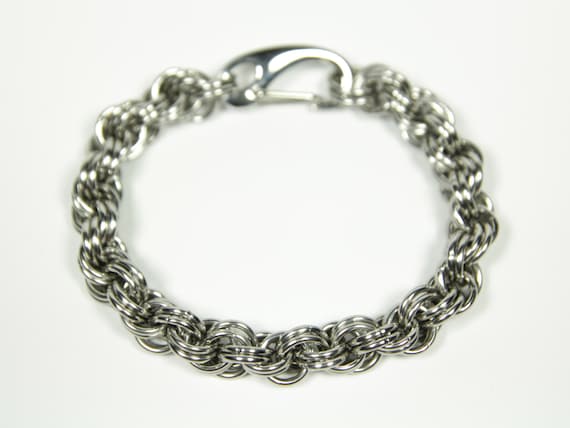
Another option is a spiral 8-in-2 (instead of 4-in-1) but the end result isn't nearly so slinky and serpentine. Here's an example from Van Alphen Studio:

Double Spiral 8-in-2 Maille Bracelet by Van Alphen Studio


3. So I did some digging off-and-on and found a couple of other weaves that I liked! The first was a weave called This Is Not Food, which naturally retains a clean spiral shape and, because of the small jump rings you use to lock the spiral, has a funky, spiky look to it. I didn't love it at first—I liked it, but I didn't love it—but now it's grown on me.

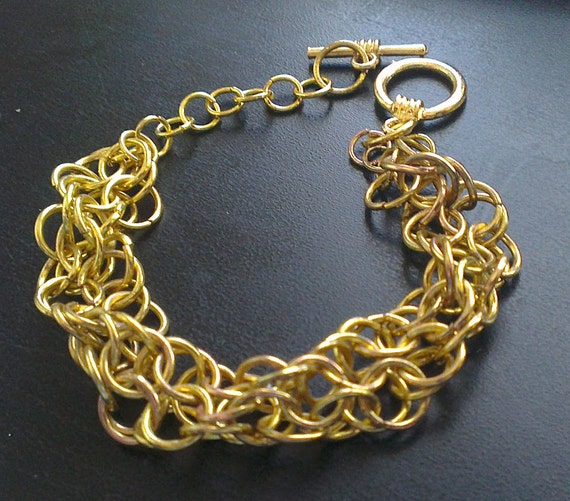
Double Helix Chainmaille Bracelets (This Is Not Food) by Kokoba
4. At some point I got the idea to see if I could do something with Viking knit and accent beads. While these didn't turn out as I had hoped, they still turned out nicely. This is something I plan on returning to in the future. I love Viking knit too much not to use it.

Double Helix Viking Knit Bracelet

Double Helix Viking Knit Necklace

5. Around the same time I found This Is Not Food, I found Lorraine's Inverted Spiral, which I loved for the sleekness of the profile and for the uniformity of the rings. (This Is Not Food requires jump rings of two different sizes.) I worked out a prototype bracelet over the winter holidays last year, and made it harder on myself by choosing a monochrome (rather than a two-tone) theme.

Double Helix Chainmaille Bracelet (Inverted Spiral) by Kokoba
What I realize now is that the two-tone scheme, in addition to making the weaving much, much easier, also serves to make the spiral shape clear. I will, of course, still offer monochrome options in the shop for anyone who wants that sort of thing, but I just personally prefer the two-tone version. Now that I was comfortable with the weave (almost a year later), I could take the next step and invest in a special jump ring order from The Ring Lord rather than pull from my generous stock of jewelry findings. The rings in this new piece are anodized aluminum, rather than the nickel/copper/zinc alloy I usually use.

Black/Champagne Double Helix Maille Bracelet

The result is something lightweight and comfortable (and also really pretty!), and something I will definitely be making more of. Of course, I realize now that the way I first learned to spiral in this weave creates the infamous left-handed DNA. Sigh. The good news is that it was surprisingly easy to correct this technical flaw. As of this post, I have both this left-handed bracelet and a proper right-handed bracelet listed in the Kokoba Etsy shop. (I'm not redoing this one, though. Either someone loves it, in all its inaccuracy, or I get to keep it and wear it and look fly. Either way works for me!)

There it is: the eight-year evolution of an idea. Is this the last iteration? Who knows!

Monday, August 29, 2016

Newly Listed: Viking Knit DNA Jewelry

Back in my yoga post, I mentioned that my favorite part about yoga was having chill-ass "me time" where I could think things through and get inspiration. Well, what you see here today is a result of that inspiration!

I first picked up Viking knit six (!!) years ago, but all told I haven't used it in many projects since then. While I enjoy the repetitive nature of it—it's a great way to keep your hands busy while you're watching TV, riding in a car, or listening to a podcast—and the end result looks really nice, I couldn't think of a way to incorporate it into my STEM jewelery (STEMery?) except as a space holder; a way to lengthen a necklace (such as Avogadro's number or Big G) that would otherwise be impossibly short.

Sometime later I saw a design with small beads woven into it, and that made an impression. Then in the middle of a yoga session, I drew the connection between the impression and my work: would it possible to weave beads in a particular shape? Say, a double helix?

As of this post, I'm not entirely sure of the answer. Viking knit is a two-part process; what you see while you're working on the thing is not really what you get by the end, after you pull everything through a draw plate a few times. So far I have two prototypes.

Copper Viking knit sciart biology jewelry DNA necklace
Copper Viking knit necklace inspired by DNA
Copper Viking knit sciart biology jewelry DNA bracelet
Copper Viking knit bracelet inspired by DNA
While they didn't turn out exactly how I envisioned them, they're still lovely pieces! So I'm offering both in the shop at a reduced price. They're still experiments, after all. Educational pieces.

I've done a little bit of searching around and I don't think anyone has tried to do what I'm trying to do. If they have, they're not writing blog posts or tutorials about it. Unfortunately, these two projects used up the last of my copper wire, so things will have to wait a bit!

Tuesday, May 3, 2016

Talky Tuesday: 48 Days of Blue

#48DaysofBlue


I first caught wind of the #48DaysofBlue campaign via Natalie. I signed up immediately, because I love the ocean. Uh, duh, I guess. We all love the ocean, I know; it's a cliche at this point to rhapsodize about living on the beach. But I mean for real: I. love. the ocean. I love the experience of being in the water or on a boat or whatever, but more than that, we all kind of take the ocean for granted. At best, we don't really understand just how essential the oceans are for human life as it's come to be. 

But before I go on, you should go and sign up for #48DaysofBlue. Every day from Earth Day (already over, oops) to World Oceans Day (June 8th), you'll get a simple, actionable challenge you can do to help the oceans and to shift your thinking and habits to be more ocean-friendly.

Seriously, go now.

Okay, now you're back.

Since, as of this writing, I'm a few challenges behind, I'm going to get caught up on a whole bunch at once. You can do it, too!

Days 2 & 3: The Lights-Out Dinner
This weekend’s challenge is to host a lights-out dinner! 
Once you’ve loaded the dishwasher with the plates from tonight’s feast, take a minute to look into the types of lighting around your house. When it comes to replacing lightbulbs, go for the more energy-efficient options, like CFLs or LEDs. And of course, leave the lights off whenever the opportunity arises. 
In the summer, keeping the lights off can even help cool down a room!
This one was a bit of a shoo-in for me: I live in Sweden, where CFLs and LEDs have been the norm for way, way longer than they've been in the US and our preference for incandescent lighting. Our apartment is also so small that it's impossible to forget to turn off the lights—if I leave them on in the kitchen/my office, it's too light to fall asleep.

Now that we're past the vernal equinox here in Sweden, the days are only going to get longer, until we could conceivably never have to turn on the lights? That would be an interesting challenge: use only sunlight for light in the summer.

But I'll admit: I didn't go for the full-on lights-out dinner.

Day 4: Skip the Straw


Did you know that Americans use (and throw away) about 500 million plastic straws each day? That’s enough plastic to fill 127 school buses!
Still want to sip that soda through a straw? Or maybe your kiddo needs the help? No problem. Ditch the disposables, and try a reusable glass straw instead—some companies, like Simply Straws, even offer a bendy option!
If you want to make an even bigger impact, encourage local restaurants and bars to go straw-less with you. When you’re out to eat and notice a restaurant serving drinks with straws included, have a quick chat with a manager. Ask them to help support the strawless cause by bringing drinks to the table sans straw!
This simple switch could keep a considerable amount of plastic from our waterways.
So, this challenge is interesting. JV loves straws. He has a tendency to underhydrate (he's one of those people who just doesn't get thirsty), so generally anything that gets him to drink more I'm in favor of. But I've known for a while that plastic straws are a mess, so it's one of those times where either your health or the health of the planet is going to lose out and you've just got to make the call....right?

Maybe not anymore! This challenge alerted me to Simply Straws. I think I know what I'm going to get JV for Christmas now—and an extra wide one for myself, because smoothies just taste better through a straw.


Day 5: Skip the Stream
Did you know? You can save up to 20 gallons of water by skipping the stream each time you wash your dishes! 
Looking for more ways to conserve water while washing dishes? Don’t get too generous with the dish soap. Those extra suds translate to extra water—reduce rinse time by using only the soap you need. 
If you’re using a dishwasher, make sure you have a full load before hitting start, and opt for an eco-friendly detergent.
We don't have a stream option on our tap, so this one is another moot point. Our detergent of choice isn't labeled as eco-friendly, but we're nearly out of dish soap anyway, so I can pick up the green version of this brand. I'm already stingy with the dish soap.


Day 6: Trash Journal

Skipped this one; we're very good about recycling and right now I don't need the pressure of BE THE PERFECT RECYCLER in my life. I saved this one for another day.


Day 7: Beware of Vampires


Did you know that dormant electricity can account for 5 to 10 percent of your home’s energy use? 
According to the U.S. Department of Energy, appliances use about 75 percent of their energy when they’re turned off. 
Take a scan of your home and unplug the appliances you’re not using. Toasters, coffee makers, microwaves, lamps, phone chargers, game systems—the list goes on and on. And don’t forget about the office! Taking the extra effort to shut off your computer at the end of the day can help save energy. 
For convenience, plug appliances into a central power strip with an on/off switch. Turning off the power strip simultaneously cuts the power to all of those electronics, keeping the energy vampires at bay.

This is good to do. I am guilty of just letting my laptop run constantly. I don't really need to (except for Cookie Clicker); I should probably start hibernating it when I go to sleep. JV is much more responsible than me and shuts his laptop down every night.

Unplugging is a tougher question. We unplug things when we go on trips, but our outlets are not all easily accessible for easy access.

But, on the plus side, we also have the option of switching our power source to wind! (Even though we're one of like 90 apartments in this building; I don't know how they can individually allocate power sources like that and I suspect it's some kind of math magic but close enough.) It comes at no extra cost to our current (ha, ha) energy bill so I don't know why we haven't done it already. Oh wait, yes I do: we both hate calling people on the phone about anything. >.<

So as of this early blog writing (on Thursday the 28th), these are all of the challenges that have been available so far.

Even though things have already started, you can still sign up for #48DaysofBlue! It doesn't have to take a lot to make a difference. :)


Friday, March 25, 2016

Five Fandom Friday: 5 SciArt Shops You Should Know


It's been a while since I've been up for a 5 Fandom Friday, but this one was right in my wheelhouse! ....almost.

So, like I brought up in my last Talky Tuesday post, I'm not much of a shopper. I don't have five favorite anything shops, let alone geeky shops, to buy from because I keep my pursestrings closed and also I buy books more than anything else oop. Even when I do shop, I'm not much of a fandom shopper. But I do have five favorite sciart shops you should know! I have more than five, really, but these are a good start.

What is sciart?

Sciart is the intersection of science and art. STEM and the humanities, despite popular belief, are not mutually exclusive. The goal of sciart is to highlight how the arts propel the sciences, and how the sciences enrich the arts.

1. ArtAtomic

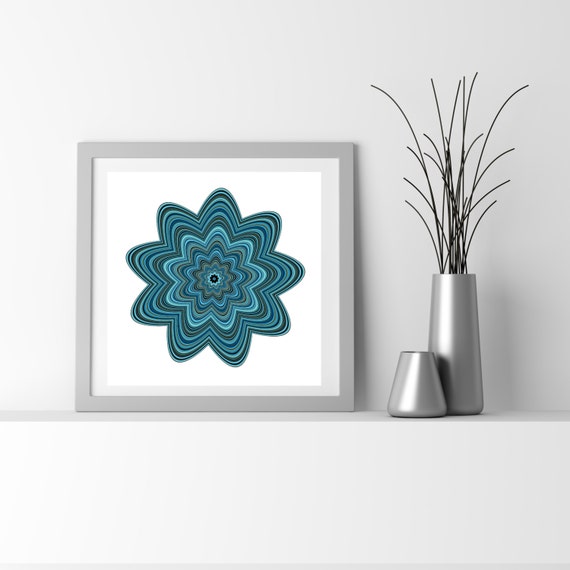
Kristin Henry uses her coding knowledge and programming experience to create really cool generative geometrical art. Do you need a modern geometric print to hang up in your living space? Or a coloring book? Maybe a new scarf?

Abstract Art Particle Flower by ArtAtomic
2. ChrissySparksArt

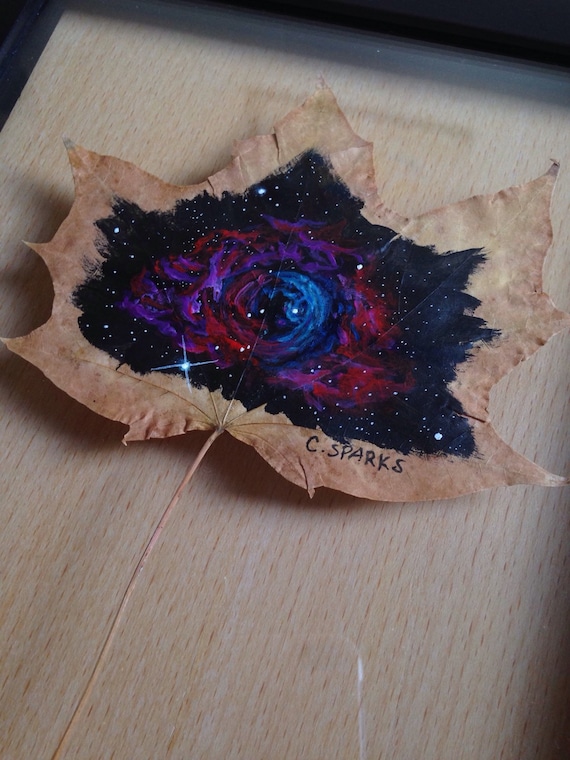
Do you love astronomy? Did you have childhood dreams of going to space camp? Do you have opinions about Pluto? Then you will love the art and jewelry from ChrissySparksArt. I think my favorite thing in her shop are the leaf paintings. They are something out of William Blake:
To see a world in a grain of sand,
 And a heaven in a wild flower,
Hold infinity in the palm of your hand,
  And eternity in an hour.
Bubble Nebula Cosmic Leaf Art by ChrissySparksArt


3. The Occasional Bat

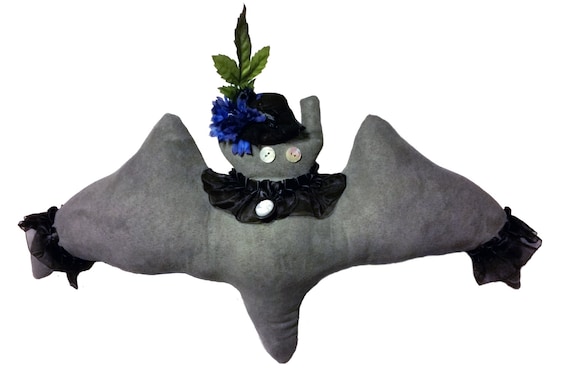
It is no secret that I love bats, and The Occasional Bat has the most adorable bat plushies imaginable.

Gray Victorian Bat by The Occasional Bat
But The Occasional Bat is about more than just cuteness—they do bat outreach as well. A portion of their proceeds on every sale go to the Florida Bat Conservancy and to the Bat World bat sanctuary in Mineral Wells, TX. We're still a long way from curing White Nose Syndrome (though progress has been made), so these little guys need all the help they can get. They also do custom bats for (as the name implies) any occasion!


4. The Vexed Muddler

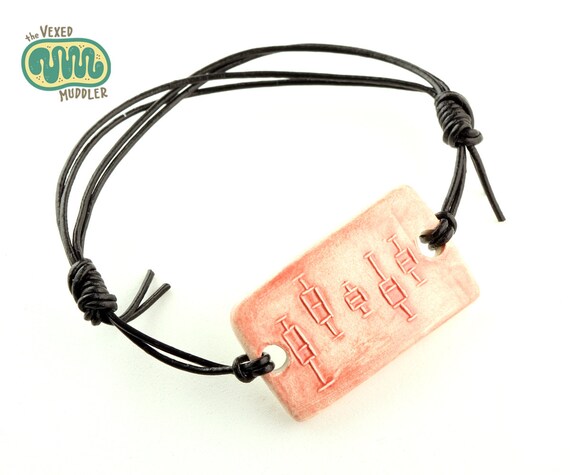
Peggy of The Vexed Muddler is just all around really cool. I follow her on Twitter and her tweets make my day. So Peggy would be cool even if she didn't make sciart ceramics and cool t-shirt and temporary tattoo designs, but she does, so she's just even cooler.

Box and whisker graph bracelet by The Vexed Muddler
And if you wanted a beaded or chainmaille thingummy to go with one of her pendants, I could help you out. Jus' sayin'.


5. ESeas

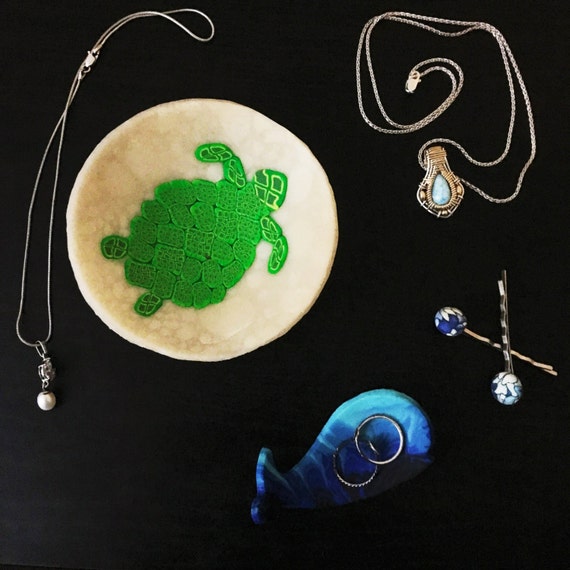
For those who prefer that their sciart be a little more functional, Elizabeth Sargent of ESeas sculpts fantastic dishes out of polymer clay. If you have an absent-minded science professor in your life, one of Elizabeth's trinket dishes might make them a little more organized.

Sea turtle trinket dish by ESeas
If none of these are to your style (and I have a hard time believing that), then all you have to do is browse the sciart hashtag on Twitter to find lots of great designs and art. I swear, every time I check up on that hashtag I find two or three awesome new designers/bloggers/scientists to follow. It is an embarrassment of riches, y'all.

Wednesday, February 10, 2016

What I Read: Cure

A perpetual item on my 101 in 1001 list (guess I should update about that one at some point! today is not that day, though) is to read one nonfiction book a month. I love novels and literature, but I also am endlessly curious about the world around me. So you can imagine how my eyes lit up when I saw that Cure was one of the books available for me on Blogging For Books. I requested it the same day I signed up and, after a little futzing around with NetGalley and Amazon, I dove right in.

Image courtesy Crown Publishers


The full title is Cure: A Journey Into the Science of Mind Over Body, and it's right what it says on the tin. The one thing I'd like to add is that when Marchant uses the word "science" in the subtitle there, she means good, solid science—not some fuzzier woo usage of "science." The entire book is built on extensive interviews with professional scientists: experts in medicine, human physiology, biology, genetics, and so forth. It's also built on the premise that Western, evidence-based medicine mostly works and has been a net boon to society. There is no "you can cure your cancer with positive thinking!" or "vaccines cause autism!" quackery going on here.

The reasonable hypothesis that Marchant explores in the book is that the placebo effect, as well as feeling cared for, is an underrated and potentially immensely useful tool in our healthcare arsenal. For many people with a more materialist view of things, this can seem like nonsense, or uncomfortably close to lying. Materialism—that all we are is the body and its physical components and interactions—has driven Western medicine for years. Marchant challenges that view and offers a more pragmatic one: however you feel about the inherent honesty of offering a placebo, we can't deny that the placebo effect works.

There is case study after case study in her book about chronically ill patients who, say, underwent a sham surgery and still reported a drastic decrease in pain and quality of life; or who have been able to reduce the dosage of powerful immuno-suppressive or stimulant drugs by taking a placebo alongside their regular medication, or by forging strong mental associations between their medicine and a particular concept. They're all fascinating to read, and Marchant approaches all of them with respect and good-natured interest without veering into condescension. It's pretty much impossible for me to pick a favorite; instead, I want to focus on the  limits of the placebo effect.

Marchant gets to the limits of what the placebo effect can do right in the first chapter (though not before a juicy hook, natch). It has to do with altitude sickness.

Fabrizio Benedetti has a high-altitude lab in the Alps. I don't know how he finds study subjects, but he does—and he encourages them to travel to his lab as quickly as possible, rather than the suggested staggered journey, so as to maximize their altitude sickness. Then he runs all kinds of tests with diodes and treadmills and real oxygen and fake oxygen.

The results are multifaceted, but they're consistent: in a nutshell, a placebo can't fix the physical thing wrong with you (in the case of altitude sickness: a lack of oxygen in your blood), but it can do a lot to mitigate your brain's reaction to what's wrong with you—which is often what causes the worst symptoms of a sickness. In Marchant's words: "Breathing fake oxygen can cause the brain to respond as if there is more oxygen in the air, but it cannot increase the underlying level of oxygen in the blood."

Everything else that Marchant discusses later, which sometimes borders on what some would call "the miraculous," remains well within that boundary. She also points out the pitfalls of going too far woo: namely, that if you subscribe to a philosophy that illness is entirely in your mind, then when you become gravely ill, you will blame yourself for it, which is about the worst guilt trip of all time. (This victim-blaming mentality is why I side-eye The Secret so very hard.) The book is overall hopeful and fuzzy feel-goody, but this particular encounter stands out as a stark warning:
"One problem, of course, is that patients who adopt alternative medicines do not always have a positive outcome. While researching this book, for example, I met 37-year-old Tunde Balogh. Originally from Hungary, she lives in Ireland with her husband and young son...A year earlier, she had been diagnosed with cancer in her right breast. 'I was so against doctors, hospitals, nurses,' she told me, '...I knew inside—if I caused this I can fix this.' Then she found German New Medicine, which teaches that cancer is caused by emotional conflict...Tunde says this resonated with her, because insecurities about her body had been causing her to distance herself from her husband. 'Why did you do that, now you have cancer!' she says. 'It took me around six months to forgive myself.' 
But her cancer wasn't cured. In January 2014, she started suffering from searing joint pains; the disease had spread to her bones. 'Cancer in the bones is when you don't feel valuable,' she says. She stood in front of the bedroom mirror each day, repeating: 'I'm valuable. I love myself.' 
By June, Tunde struggled to walk and was in severe pain. She was as convinced as ever that the answer was inside her, though, and still searching for a cure."
There is definitely a place for evidence-based medicine in Marchant's schema. Not only that; it's absolutely essential. Nearly all of the best possible effects and outcomes in Marchant's case studies are due to the combination of evidence-based medicine and the placebo effect, rather than just one or the other.

Still, even within those limits, the placebo effect can accomplish some incredible things. The only question Marchant doesn't really touch on (and this may be because we don't know the answer yet) is why the placebo effect works for some people, but not others. Is it just random? Does it have to do with personality, habits, psychology?

There's more to this book than the placebo effect. Marchant also investigates, to a more limited extent, the social determinants of health, defined by the WHO as "the conditions in which people are born, grow, work, live, and age, and the wider set of forces and systems shaping the conditions of daily life." It's not just genetics and lifestyle choices that affect your health: where you're born, what kind of lives your parents and even grandparents had (separate from the genetic predispositions they passed on to you), and even the kind of stresses and relationships you had as child and teenager all seem to have long-lasting physiological effects.

All in all, Cure is a quick but by no means shallow read. Some might accuse Marchant of trying to pander, or to play to both sides (instead of coming down hard on woo), but I think those critics are coming down way too harsh. The truth is, our brain is a fantastically complex organ and not only do we not know how it all works, we don't even know how much we don't know. Even if just a handful of the therapies Marchant investigates were to bear out in real life use, it would mean an incredible improvement in the quality of life for millions of people worldwide. Hopefully Cure will nudge the popular and medical consciousness towards implementing these therapies.


I received a free copy of this book from NetGalley and Blogging For Books in exchange for an honest review. And trust me: I don't hold back when I think something is bullshit.

Monday, February 8, 2016

Newly Listed: DNA Maille Bracelet

I've been busy lately (or rather, I've not been good about time management lately), so this newly listed piece is actually something I worked on over the holidays. It represents me mastering a new weave (one I should go back and practice—I'm reading Fluent Forever and so now I have spaced repetition on the brain), so in terms of time and value, I'm selling this one at a loss. But as far as learning pieces go, it looks pretty good, so why not sell it? I've been known to wear it myself, on occasion.

Sciart nerdy biology science jewelry gift DNA double helix maille bracelet
DNA Double Helix Spiral Maille Bracelet
I think, looking at this photo and all of the other ones in the listing, that I'll need to take some better (i.e. not rushed) photographs. It has a wonderful spiral shape to it, but you can't quite see it from this angle. Of course, if you already like it...

The weave I used was the "inverted spiral," credited to Lorraine Menard. You can see the shape better in her sample projects here:

Inverted spiral maille earrings by Lorraine Menard
The next project I do in this weave will probably use two-tone rings, as pictured here. That might help visually organize the shape better. Or the issue might be a purely physical one (the weave will look different laying flat versus hanging freely). We'll see!

But first I need to pass Russian.

Anyway, in lieu of the usual #sciart Twitter links, I want to share just one story I saw on Facebook:

3D-Printed, Acoustically-Generated Ceramics

For the link-phobic, a laboratory in the Netherlands uses a combination of 3D-printing, ceramics, and acoustics to create vases and other goods that retain the physicality of sound—basically, the vibrations of the sound coming through the speakers vibrates the pottery-in-progress, and as a result creates patterns.

Pieces from "Solid Vibration" at Studio Van Broekhoven


The demo video only uses loud WUB WUB style dubstep bass; I would love to see one "created" by, say, Ride of the Valkyries. Or Misirlou. For more information on the process, check out Studio Van Broekhoven's official page for the "Solid Vibration" project.

Monday, January 25, 2016

Newly Listed: Newtonian Constant of Gravitation in Australian Opal and Fancy Jasper

Things have been a little quiet around here lately. I have to admit: I'm caught up in some really fascinating new reading and also Fallout New Vegas. But I've kept my hands busy, too!

This physics sciart science bracelet, featuring the Newtonian constant of gravitation in genuine Australian opal and fancy jasper, would make a great science gift for nerds, physicists, and teachers.
Newtonian constant of gravitation in genuine Australian opal and fancy jasper


Like I've said earlier, I've started really digging into the depths of my bead stash to try and clear out as much as possible. The fancy jasper beads in this bracelet are an example of that. The opal, on the other hand, is a relatively new addition to the bead box. It was a pretty luxurious buy, so this is a piece where I've opted to use some of my sterling findings instead of just base metal. Yes, sometimes I get fancy!

This physics sciart science bracelet, featuring the Newtonian constant of gravitation in genuine Australian opal and fancy jasper, would make a great science gift for nerds, physicists, and teachers.


This would be a great treat for any science nerds you know with an October birthday, or just a passion for opal (or Australia!). Go on, indulge.

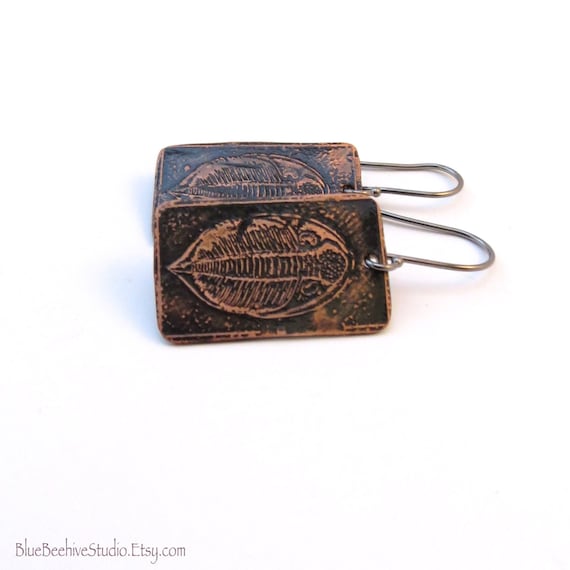
If you just feel like window shopping today, be sure to stop by The Blue Beehive. Despite being open since 2012, they only just now turned up in my latest sciart search on Etsy. They have a wonderful mix of sciart and just art, like these:

Etched copper trilobite earrings


and this:

Boho style single wrap bracelet

And as always, Twitter is chock full of sciart finds!


Monday, January 11, 2016

Newly Listed: Speed of Light in Snow Quartz and Faceted Amethyst

Back when I was working on SUPER SEKRIT PROJECT (it's done now; all that's left is to count down the days until I can share it with you!), I bought a whole bunch of a kind of stone entirely new to me: snow quartz (also called snowy quartz, milky quartz, and white quartz). It was something I could use in so many projects, when moonstone was too expensive and when mother-of-pearl was too warm.

In so many projects, it turned out, that I used it all up before writing a geo-shopping post about it. Oops!

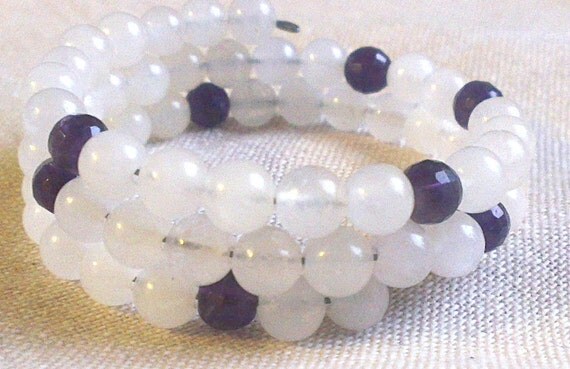
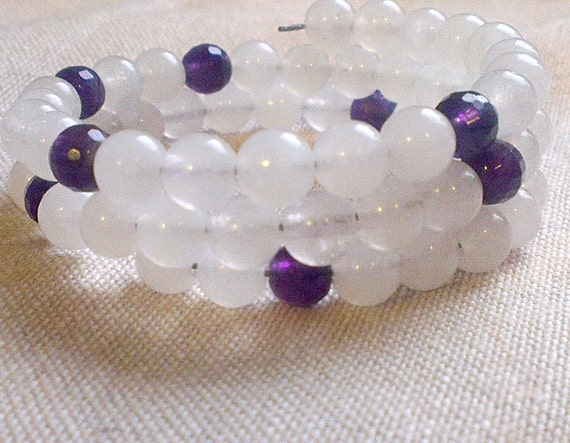
In the meantime, feast your eyes on this latest piece of sciart jewelry: the speed of light in snow quartz, with faceted amethyst acting as spacers.

Physics teacher steminism sciart gift: speed of light science bracelet jewelry
Speed of light bracelet by Kokoba
This is only the second speed of light piece in my shop and (according to my photo backlog) the third I've ever done. How could I forget one of the most important physical constants there is? I don't know, but I'm determined to rectify that situation.


This would be a great gift for any physics nerds or hard SF fans you know, whether for Valentine's day or for a February birthday (since amethyst is February's birthstone).

Last week, I decided to dig on Etsy for some #sciart finds. This week I originally planned on searching on Pinterest, but you know what? Either Pinterest users are idiots, or there is something fucky with their algorithms (why not both?), because the vast majority of stuff that turns up when you search for "#sciart" is fairies and fantasy things. And, for some reason, fashion color palette advice based on your "season."

Meanwhile, if you search #sciart on Twitter, you get some really nifty new stuff! Like neurons painted in sumi-e style:


Some immunology jewelry from the fantastic Vexed Muddler:


And some breathtaking marine biology:


So, sorry Pinterest: you were a cool idea but for now I'm going to stick to recipes, thanks.

Saturday, January 2, 2016

Skeptical Saturday: Why Your Resolution to Lose Weight is Doomed to Failure (And Also Bullshit to Begin With)

Natalie asked if this was going to become a regular feature on the blog, and I joked that if I were to do that, I'd probably give myself a coronary. But I guess the holiday season is just rife with things that piss me off, so here's another one a lot sooner than you should probably expect!

Why is my weight loss resolution doomed to failure?

From the best studies we have on the topic, around 95% of calorie-restrictive diets fail. The odds are stacked against you, especially if you're set on dropping anything greater than around 10% of your starting weight—that seems to be the highest amount you're likely to keep off.

There are freakshows, and there will always be freakshows, but you have a 5% chance of becoming one of them. Not only that, but the price of being that 5% freakshow is eternal fucking vigilance.

FreeIImages.com / Miguel Saavedra
Not just around food, but around exercise, too. You better learn to love the gym because you'll have to exercise an extra hour every day to maintain this new, smaller body compared to someone else who was always that size. Very few of us have the lifestyle to make that much exercise (since your job is probably something sedentary) a priority for the rest of our lives. If you read no other link in here, read the one in the previous paragraph ("The Fat Trap," New York Times). Or here, I'll quote what permanent, successful, significant weight loss entails:

Janice Bridge, a registry member who has successfully maintained a 135-pound weight loss for about five years, is a perfect example... 
Since October 2006 she has weighed herself every morning and recorded the result in a weight diary. She even carries a scale with her when she travels. In the past six years, she made only one exception to this routine: a two-week, no-weigh vacation in Hawaii. 
She always weighs everything in her kitchen. She knows that lettuce is about 5 calories a cup, while flour is about 400. If she goes out to dinner, she conducts a web search first to look at the menu and calculate calories to help her decide what to order. She avoids anything with sugar or white flour, what she calls her "gateway drugs" for cravings and overeating...She writes down everything she eats. At night, she transfers all the information to an electronic record...
Bridge also supports her careful regimen with an equally rigorous regimen of physical activity. She exercises from 100 to 120 minutes a day, six or seven days a week*, often by riding her bicycle to the gym, where she takes a water-aerobics class.
*Editor's note: For comparison, the American Heart Association's official recommendation is 30 - 50 minutes of cardiovascular exercise a day, three days a week, for optimal heart health.


So that's why you're doomed to failure! But there's good news: it was a bullshit goal to begin with. You were duped, and there's a better way.


Why was it bullshit?

A couple of years ago, I wrote up a post on the bogus science of BMI for NEDA's Eating Disorder Awareness Week. If you haven't read it already, go check it out now!

This is relevant here because you often hear about lower or higher BMIs being associated with this or that, when the truth is that BMI is a flawed model that was originally intended as a statistical tool in the 1800s and was appropriated by insurance companies (not doctors, not scientists, not knowledgeable health professionals) to decide who were and weren't high-risk customers—that is, customers more prone to having heart attacks.

Now we take BMI as medical gospel when nothing could be further from the truth. It basically renders all of those studies you hear about being "too fat" having something to do with this or that medical malady inherently flawed, because their criterion for "too fat" is inherently flawed.


"Okay," you argue, "I cede your point that BMI is a broken system that would be better replaced by more accurate measurements of muscle-to-fat ratios specifically. But we can all agree that having too much fat is, objectively, bad for you. You said yourself that we've known since the 1700s that larger people tend to die earlier, after all."

You know how when you hit puberty, your parents, teachers, and helpful books told you that you need to shower every day? Because it's good hygiene? Yeah, that's a marketing scam from soap companies in the beginning of the 20th century. Advertisers convinced people that they were just secretly stinky and that their friends were gossiping about them because of it, so it became "common sense" that you should bathe every day for the sake of hygiene. In actuality, your skin does a good job of handling bacteria and icky things, and once a week is usually enough to be healthy and hygienic, really—so long as you're not training for an Ironman or Tough Mudder every day, or handling sewage or hazardous waste.  (You should still brush and floss every day, and you should still wash your hands with soap and water before preparing food and after using the toilet. But that's something else entirely.)


It's that same kind of common sense (OR "COM-NONSENSE" AMIRITE????!!!) we're seeing with fat and obesity now. Everyone "just knows" that it's unhealthy to be fat, but any study that avoids the trap of using BMI as a sorting tool almost always fails to take into account social stigma and how that affects health. Really, you "just know" that being fat is unhealthy because everyone is mindlessly repeating it: advertisements, your clueless Facebook friends, Michelle Obama. (Advertisements especially. Do you realize how much bank companies like NutriSystem, Jenny Craig, and WeightWatchers make? Never mind gyms that deliberately overbook their memberships because they know that people will panic about being fat or unhealthy but then most likely not actually turn up? Books about this or that new fad diet?)

In reality, it's actually very difficult to tell if it's fat that makes you ill, or the stigma around being fat. If fat people are dying earlier, is it because they're fat, or because they put off going to the doctor, sometimes to the point that whatever medical intervention they receive is less effective? Is it because even when they go to the doctor, doctors often dismiss legitimate medical complaints as just being a result of their obesity?  Is it because we have no way of knowing which of these fat people haven't given into the pressure from society to lose weight, only to go and gain a whole bunch more back—a process called yo-yo dieting or "weight cycling" that can cause long-term damage? Is it because they can receive hundreds of messages a day from media, friends, and family that they are unhealthy, an Other, a less-than, leaving them in a state of perpetual semi-stressedness? Elevated stress hormones are demonstrably bad for you, and as long as we keep treating fat people like shit we'll never know if having fat elevates those hormones or if it's people being dicks (it's probably people being dicks, though).

Why were larger people keeling over from heart attacks 200 years ago? Who knows? Maybe it was too much food and not enough physical movement that did it—making fat a symptom of an underlying problem rather a problem and in and of itself. Maybe it was something they ate. Maybe it was stress. Maybe it was a direct result of too much body fat. Maybe it was just a huge coincidence.

The truth is that the fear of fat is a marketing tool designed to make you feel bad about yourself, no matter what. If you're already thin, the fear is of becoming fat. If you're average, the (misguided) fear is that you're already too fat. If you're actually fat, well, how could you not feel bad about yourself? A capitalist society wants people to be insecure and unsure of themselves because that's how companies can sell more items. (Remember that soap example I mentioned earlier?) This isn't tinhattery; this is how marketing works. This method is called "the halitosis method," after Listerine's unbelievably successful campaign to get people to start using mouthwash—by creating an imaginary enemy called "halitosis" and then selling you the solution.

If no one felt bad about their bodies, companies like Weight Watchers, Jenny Craig, and NutriSystem would be out of business. Most of the "casual gyms" across the country (as opposed to the hardcore bodybuilding gyms) would close their doors as well. We would no longer compulsively buy clothes and cosmetics we don't need in an attempt to look/feel beautiful (or that we need to buy because of endless yo-yo dieting and closet purges). Hell, how many blogs that you follow would suddenly have nothing left to sell or say? There are lots of people invested in you feeling like crap, and invested in you trying to "better yourself" according to society's impossible beauty standards and also moral health imperatives.

This is where I see a lot of people try to sidestep all of this. "I don't care how I look," they claim, "I just want to be healthier."

Who told you that you weren't already healthy? Who told you that you have a moral imperative to be healthy? Who told you that less of you means a healthier you? Who told you that being fit and athletically competent was a good barometer of health?

How do you feel?


How can we do this better?

If you're feeling sluggish, achey, or otherwise unwell, then yes: you might well benefit from moving more, or from making changes in your diet. If you're having a hard time keeping up with friends in your favorite physical hobbies, you would probably be happier if you invested in some more training.

Because there is nothing wrong with wanting to feel better. I picked up a lot of awful habits in college, but one good one was keeping an eye on my fiber intake because I learned that without it, I could be left in excruciating abdominal pain that wouldn't relent for days. Gallstones? Constipation? Lactose intolerance? Hell if I know, but I figured out a change that worked and I made it part of my adult life. Did I get thinner? Temporarily, only. But was I in less pain? Permanently. Did I feel better? Permanently.

People who have lost a lot of weight claim to suddenly feel better in a similar way. Is it because they've started moving and eating a more balanced, nutrient-rich diet, rather than because they're smaller? Is it a psychological thing about successfully belonging to the group? Most likely. Is it just because they're smaller? That the shrinking of their fat cells kickstarted some mysterious and positive metabolic process? Probably not.

If you make the resolution a habit, and you make it for its own sake rather than wanting to be smaller, you'll succeed. For more on creating and achieving habit-based goals, please read this series on habits at Power, Peace, and the Porch Gym. And don't do it as a mind hack to "win" at dieting. Very few people win at dieting, even with the "not a diet" diet. Do it because you will be stronger, sleep better, have more energy, or be in less pain. Do it because those are things that you value and want in your life. Not because you want to be smaller. Not because someone else told you that those are things you should value.

You are enough. Just as you are.

Tuesday, October 27, 2015

The Science Tarot

If you've been following this blog for any length of time, you know that I'm a sucker for a good sciart project. What you may not know is that I'm also a Tarot and all-around esoteric enthusiast.

This isn't something I discuss a whole lot, as people are usually ready to jump down my throat or ascribe certain beliefs/character faults to me that are, frankly, untrue. They assume I'm like William Shatner or that old guy in that Twilight Zone episode—no, not Terror at 28,000 Feet, I mean Nick of Time—which really could not be further from the truth.

I like the symbolism of the cards, I like how people interpret them in new and creative ways, I like using them for stories and writing, and once in a while they're even a useful tool for clarifying your own thinking on a topic. Personally, I think the art of reading meaning into a bunch of randomly-generated symbols is a useful life skill to have, whether it's Tarot or runes or I Ching or tea leaves or whatever. It can help you look at a problem or an issue from a completely wack-a-doo angle that nonetheless gives you the perspective you need.

Imagine my excitement, then, when I discovered The Science Tarot. I think it may have originated on Etsy, but now you can purchase the deck via their standalone website. (Good for them!)

If you don't already know, a Tarot deck consists of 3 groups of cards: the Major Arcana, or Trumps, which are probably what you think of when you think of Tarot;


The Magician (Pamela Colman-Smith/Alfred Waite)


 the Minor Arcana, or pips, which have four different suits numbered from Ace to 10;

3 of Swords, ibid.

and the court cards, most of whom you probably would recognize in a contemporary playing card deck (same as the pips).


King of Wands, ibid.

(A big thanks to Wikipedia editor Fuzzypeg for dutifully scanning and uploading the images from the original, public domain 1909 Colman-Smith/Waite deck!)

Put together by a team of artists, scientists, and artists/scientists, The Science Tarot has reimagined each group of cards while attempting to retain their original meaning. The Major Arcana are now "science stories," such as Mendel and his peas or Schrödinger's Cat. The court cards are, intuitively, famous scientists. categorized based on Helen Fisher's work in personality and attraction. The Minor Arcana are illustrated scientific concepts, like chaos theory, cocoon, fusion, or catastrophe. For example, here is The Science Tarot's 2 of Swords:


2 of Swords from The Science Tarot, art by Shari Arai DeBoer.
Sitting under the apple tree, we contemplate a choice to be made. The tree branch lifts an apple high in the air, and gravity continuously pulls it toward the ground. These equal and opposite forces hold the apple in place. But soon the balance may shift and the apple may fall, releasing the branch from its burden and shaking the leaves as they swing upwards.

Isaac Newton observed that every action caused an equal and opposite reaction and so reasoned that every reaction could be predicted from the action that triggered it. Like a game of billiards, Newton's world is a predictable knocking around of objects: the force of the impact equals the mass of the moving object times its acceleration. To send an apple flying in a specific direction, we only need to know where to hit it and how hard. To move a gigantic apple, we'll need to hit it with a great deal of mass, or we will need a running start.

A decision is hanging over your head. You can choose to leave the apple suspended in the tree, or you can apply enough force to bring it down. Either decision may bring good results, but if you wait too long, the apple may fall on your head.

Hero's Journey, Step 2: Refusal of the call. The hero is reluctant to use this new power.
The suits of the Minor Arcana (swords, wands, pentacles, cups) are also given their own particular theme: Wands as creation, the nuclear fusion burning in each star; then Pentacles as exchange, elements forged in the star now coalescing into matter; Swords as scientific observation, the higher thinking of conscious life and the beginning of abstract, scientific fields like mathematics, chaos theory, and physics; and finally Cups as the integration of the scientific consciousness into a more holistic picture of life and the return of the scientific observer to a participant in the system. The deck creators also employed Joseph Campbell's Hero's Journey to tell the "story" of the Minor Arcana suits, for that extra layer of meaning.

There is obviously just so much thought and attention to detail in this deck—but then, would you expect anything less from a science-themed Tarot deck?—and I am just in love.