Showing posts with label explications. Show all posts

Thursday, December 22, 2016

#TBT Electron Mass Necklace

This is a Kokoba beta release. It was originally an item for the Mad Scientists of Etsy!'s monthly challenge at some point in 2013: an item inspired by the discovery of a new species of frog that is the world's smallest vertebrate.

Image courtesy Christopher Austin, LSU
I'm still quite pleased with how it came out.

Quantum physics sciart science necklace
Electron radius necklace by Kokoba Jewelry
I tried to stick with frog-y colors, and the green aventurine beads you see there are 8 mm in diameter: around the same size of Paedophryne amauensis (which is technically an average of 7.7 mm in length). And since we're talking about something really, really small, what better way to celebrate it than with a subatomic particle?

Thursday, January 7, 2016

The Art and Science and Insecurity of Pricing on Etsy: Round 2

So! I made a bracelet. I'm sure this is all shocking to anyone who's followed me for any length of time!

The picture is not the greatest. Better ones will be up on the Facebook page tomorrow, when I have more flattering daylight. Until then, here's this noisy, low-quality, poorly-edited mess:


Sciart jewelry: speed of light bracelet for physics lovers.
Speed of light (meters per second, in a vacuum)  wrap bracelet/choker

This is a bracelet I've been thinking about making since December. Today I sat down and made it (mostly because I put it on my HabitRPG "to do" list). It took around an hour and a half to make. The beaded portion is around 16", meaning it will comfortably wrap twice around the typical wrist as a bracelet or once around the neck as a choker. (Really. Probably. If it fits comfortably on me, it will probably fit comfortably on a lot of people; I have a thick neck.)

Sometimes when I finish a project, all I feel is unequivocal pride. "Girl, you are lookin' flyyyyyy," my inner diva says, admiring the work. Other times I shrug and go, "Eh."

That is how I feel about this bracelet. Anyone who knows anything about making these guys will be able to spot some problems with my ladder stitching straight away.

So then the question is: should I sell it?  Or keep it?

I love the colors the way I would love a throw pillow, or someone else's outfit. Really cool, but not necessarily my thing to wear on my person. So it's not something I'm dying to keep (unlike some other pieces in my shop that break my heart to sell). So the answer is to sell it, right? (Assuming for the moment I have no one to give it away to. Maybe I'll give it away here. Stay tuned!)

But then here we are, to the kernel of the issue: for how much? How should I price it? If I know how I normally value my time but wish to make an exception, how can I do that?

I talked just a few weeks ago about pricing items on Etsy, which I think sellers and buyers alike should read. If it's fresh in your memory, you'll recall that one of my guidelines for pricing is: how much do I value an hour of my time? how long did an item take to make?

My going rate when pricing things is $30 an hour, or $58,000 annually if I were working full-time. (Hint: I do not make jewelry full-time.) So I'd have to think of a retail price that would be profitable if I were selling this bracelet at $45 wholesale.

Whoa child, slow down!

If this had been a "girl, you are lookin' flyyyyyy" bracelet, I'd have no issue with that amount. But it's not.

Believe me, I value my work. And I value other people's work. But you should also be able to acknowledge when a piece of work is a (re)learning experience. When you were not efficient with the time you spent on something. So I can admit to myself that this is a practice piece, and so if I want to sell it I should take the hit. How much of a hit should I take?

Well, there's the "how much do I think other people would value it" method: you can try to imagine it in a store, or scour Etsy for similar items, but this involves a lot of shopping around and, ultimately, guess work. So

Let's make it the US minimum wage of $7.25 an hour. A retail value of $22 would be completely doable in that scenario....if I wanted to earn a minimum wage that hasn't been updated or adjusted in six years ($15,000 annually). Even if I think my time is worth more than minimum wage (it is!), I now have a "basement value" for this piece. If I sell it below this price, I'm valuing my time even less than Uncle Sam does. In fact, the basement price should really be something like $25, to account for Etsy fees, the time spent photographing and then image editing, and the packaging for when it finally ships—otherwise I'd be paying myself less than minimum wage.

Let's take the minimum wage that Barack Obama mandated in 2014 for federal workers: $10.10. That would be a retail price of $30. (Makes sense: an extra $2.85 an hour = an extra $4.37 in labor costs, which when doubled to account for retail is around the $8 difference.) Now we're looking at around $19,000 annually.

As a final tier, let's take the ideal minimum wage that many activists are campaigning: $15 / hour, or half of how I normally price my time: $29,000 annually. That would call for a retail cost of $44.

Now I have a range of concrete values to choose from, depending on how "meh" I feel about this particular piece—if I still want to sell it.

Because there are other ways to see value, too. The value for me, for example, isn't only in "how much money can I make from this?" There's also value in learning or remembering a technique, and practicing it so that in the future I can do it better and more efficiently. I can value it as a step towards more even stitches, and reducing the time it takes to make a comparable bracelet from an hour and a half to maybe just one hour, or maybe even less. It won't put food on the table but it's still worthwhile.

Even given away, under the right circumstances and with the right management, would be beneficial: free advertising, increased brand recognition, and other positive things could lead to future sales. Given away free, or for the cost of shipping, also relieves me of the guilt of "not as good as it could have been," since I'm asking nothing in return.

My point here in all this rambling is that it's possible to value "practice work" monetarily as well as abstractly. (My point also is that handiwork takes time and artisan's time is worth paying for, but that is kind of always my point.)

I guess my other point is that holy crap these wrap bracelets take a long time to make and I need some protips on how to do it better and faster.

Tuesday, December 1, 2015

The Art and Science and Insecurity of Etsy Pricing

A lot of bloggers I follow shop on Etsy. A few of them shop a lot on Etsy. And some of them even have their own Etsy stores, or other handmade business. (Pimp yours in the comments, please! I have a hard time keeping track of stores and it would be great to have a whole bunch in one place so I can go and mass-favorite all of you.)

I normally have an aversion to talking shop, as it were, because I'm not exactly a success story who could reasonable considered an expert. But this is something I've come to realize is important (and it will probably betray my personal economic philosophy but oh well).

If you're selling on Etsy (or anywhere else) as a hobbyist, but you've been working in your craft for years and know what you're doing, you are probably not charging enough. (Unless you've been selling for a while, then you might have this all figured out.) If you do shopping on Etsy, you might be confused by the wide range of prices you see for similar items. What gives?

Why Aren't You Charging Enough?

Pricing your handmade work can be nerve-wracking. (FreeImages.com/Nihan Aydin)

It's certainly tempting to keep a razor-thin profit margin. "It's just a hobby, not a business," you might explain, "so I don't think charging a lot of money is really fair." Or: "I can afford it. I just want to get stuff out of my stash."

Or you might feel pressured into keeping your prices "reasonable" because you see other sellers offering something similar within a certain range.

Or you might not feel like you're talented enough to justify a price over a certain amount.

Stop. There's a better way.


Why Should You Charge More?

FreeImages.com/ilker


There are two reasons: you benefit, and others around you benefit.

How do you benefit? First of all, you actually get rewarded for your time. Not only the time it takes to sell a given item (whether it's photographs and online listings, or transportation times to and from craft fairs), but the time it takes to make a given item.

"But I don't need to be rewarded for the time I take to make something. I don't want to be! The making is fun enough."

If that's really how you feel, then donate your profits to a charity of your choice. Problem solved!

Because your time is valuable. It really is. And taking your time into account when pricing signals to consumers that they should value the time you spent on an item. Other people should respect that.

This signaling leads into my second point: others around you benefit.

Because while you may be a hobbyist who sews to take the edge off a high-pressure but well-paying job, the booth next to you may be an artisan who makes their living off their craft. If they're selling in a market full of hobbyists who are pricing their products at a hobby level instead of a retail level (never mind dirt cheap goods imported from unscrupulous and unethical overseas manufacturers), and are selling items of a similar style and quality, capitalism means they're not going to be able to compete—not unless they lower their prices. But they can't lower them indefinitely, especially when they have many more costs to factor in. And they can't explain to every customer that their doll clothing costs "so much" because they have to take their time and their overall cost of living into consideration, in addition to "just" materials.

In other words, customers often have skewed perceptions of the true value of new goods. By taking your time into consideration and valuing your time and talent as it should be, you can help skew the perception back towards something reasonable. You can signal that the time all makers spend on their craft, whether it's jewelry or soap or sewing or what have you, is valuable. Because customers have no idea who's a hobbyist and who's a full-time artisan, not without doing some digging first. Meeting them at the price point is the quickest and simplest way to do it.


Okay, How Should I Set My Prices, Then?

FreeImages.com/Bensik Imeri


Every Etsy hanger-on asshole on the Internet has an ebook out there that includes rehashed advice about how to price. You can get one of those if you want; they're probably more knowledgeable about this than I am. But it might be illuminating to see my guidelines. There are basically three rules that I follow.

1. Price everything for retail. This is probably the real secret behind pricing things yourself. Everything in my Etsy shop is listed at a retail price. This gives me wiggle room to have sales if I want to. It also means that if a vendor finds me and inquires about wholesale discounts, I won't be losing money on the sale.

I know that it feels weird, like you're somehow double-dipping. Just roll with it. Eventually you'll hit a new normal when it comes to valuing your goods.

This one is less a guideline and more of an attitude shift, but it's the most helpful one you can make.

2. I just never sell anything under $X, ever. For me, that cut-off is $10 ($10 retail). In the future I might decide to raise it, but for now I think that's a good lower boundary, considering my craft. It might be higher or lower for you, depending on how you sell. There are a lot of little things (memory wire cuffs, earrings) that I make in fairly short bursts of time. But the bottom price is always $10. It leaves a pretty wide profit margin so that I can be a little more forgiving on higher-end items. It also ensures that I earn enough to cover the cost of materials.

3. I give myself an hourly rate.  I guess you can tell that I'm not a real grown-up yet because I think of my work in terms of rates and wages instead of a salary—that's been the nature of most of the jobs I've had over the course of my adult life. It certainly helps take some of the guesswork out of pricing, because you can decide: how much do I value an hour of my time? What's the minimum I'd be okay with earning at an actual job under someone else's employ? Then keep an eye on the clock while you make to get an idea of how long items take you to make.

This might mean that some items cost less than you expected, while others cost more. This is valuable data and you should probably keep track of it somewhere, or at least try to remember it.

I certainly haven't perfected the art of pricing yet (particularly when it comes to sourcing materials), but I'm doing much better now than when I started. And while I wouldn't expect you to follow my guidelines (your craft may be quite different!), I've hopefully got you thinking about how you price your items and whether you're valuing your time.

If you peddle your wares on Etsy (or anywhere else), leave a link in the comments! Do you find it difficult to find the right price for your goods? 

Thursday, October 22, 2015

Trek Thursday: Parentheticals and Elaan of Troyius

And as we close in on my favorite TOS episode of all time, I'm pulling back for a minute to address some mistakes.

Some mistakes?

Somehow, certain episodes got overlooked. This text file was written up in a browser, then hurriedly copypasta'd into a text file, then copypasta'd back here. So things got lost in the move, as it were. If I haven't gotten to your favorite (or least favorite) episode yet, that's why!

The first correction today is Elaan of Troyius.

Where it should have been on the list: #68, so a pretty rotten episode all around.


In case you forgot: The Enterprise's mission this week is to facilitate negotiations between two kind of backwoods-y planets. To broker peace, one planet (Troyius) has offered up Elaan, who is a princess or something, in marriage. She doesn't want to at first, but Kirk helps her see the error of her silly woman ways. Also Klingons are involved, somehow.

 France Nuyen portrays one of the tougher, cooler ladies of Trek,...until she goes doe-eyed over Kirk.


TOS was not kind to women, most of the time, and this episode is a stellar (hahahah "star" pun, I slay me) example of that. "Elaan" treats the titular character like a spoiled child and every other woman on Troyius with utter contempt—there's a throwaway line about how all women on the planet are basically too uppity for their own good and that it's only the power of their love potion tears that keeps the men of Troyious beholden to them. And what's a civilization advanced enough for interplanetary space travel doing treating women like chattel? We stopped using marriages to broker peace and seal treaties quite a long time ago, because as we got smarter we learned that (surprised!) women are people, too. I don't think a culture could get smart enough for spaceships but stay too dumb for feminism.

Tuesday, September 23, 2014

Custom Piece: William-Hazens Equation Bracelet/Anklet

This was a custom order from a long while ago. I swore that I had already written it up here, but apparently I never did. (This is before I started sinking my life and to-do lists into HabitRPG, I guess.) I know I put it off for a a week or two, as I consider it bad juju to blog about a gift before it reaches its giftee. I guess the craziness of a Swedish test at the time caught up with me.

Anyway!

Kris, who works at a small start-up, was tasked with shopping for a thank-you gift for their summer intern, a sustainable engineering student in Seattle (since she worked for them for free). Kris spotted one of my irrational memory wire cuff bracelets and sent me a message about the possibility of a custom order. I jumped at the chance because I love custom orders. I love the ideas other people have about math in jewelry and/or the challenge of working within a specific color palette. This piece had both.

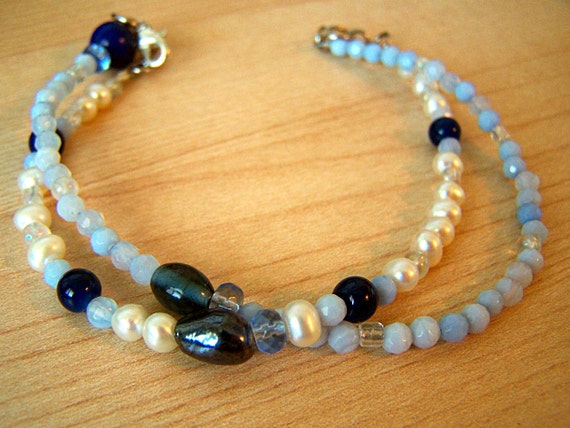
As this intern had worked quite a bit with water pressure, Kris suggested the William–Hazens equation of pressure drop and shades of blue reminiscent of water. The equation actually worked out to a near-perfect bracelet length in both the numerator and the denominator—one of the constraints of using physical constants or ratios is that you don't have much wiggle room because you have very specific (and limited) numbers to work with, so I was relieved to see there wouldn't be much fudging with lengths. In addition to the blues, I added freshwater pearls as a neutral and also to reinforce the water theme.


If you care to check this against the above link, the strand with freshwater pearls represents the numerator (the three blue beads are the spacers between each digit). The strand with blue lace agate represents the denominator (Czech glass as the spacers).

The real fun in this piece came with representing variables. I've never had to do that before—usually I work with pure numbers. But the whole thing seemed empty without any variables, so I went a little more abstract with this piece. Those heretofore unexplained large glass beads represent those variables, and the faceted blue glass you see next to them function like carats, indicating the variable is raised to a power (a power spelled out by the rest of the beads). So (large bead)(faceted rondelle)(smaller beads) means: X (large) ^ (raised to the power of; faceted rondelle) 1.85 (smaller beads).

Hopefully that made some sense!

As I said earlier, things worked out to near-perfect length, but only near perfect. I know personal preference on this varies, but I cannot stand loosey-goosey bracelets. Lawyer Mom and I have wrists that are about the same size but anything I make for her is a good two inches longer than what I make for myself, and this came out more towards the Lawyer Mom end of the spectrum. I added a few links on the end so that it can be worn as a snug-fitting anklet or loose-fitting bracelet, whatever the mood and preference.

Fortunately everything in this equation is multiplied (except the ratio itself). As you all recall from math class, when two numbers are written next to each other (ideally in parentheses), then you should multiply them. I didn't have to come up with something else to represent addition or subtraction, and I think two strands is a great way to represent a fraction/division. Maybe I should invest in some neutrally-colored "+" and "–" beads in case of just such an emergency?

All in all, this was a fun project. While I don't know if I'll be revisiting the William–Hazens equation specifically, I'm definitely going to be cruising more equations and ratios to see what I can come up with!

Tuesday, September 9, 2014

Pruning "Friday Finds" and Handmade Kokoba

I love to support fellow Etsy artisans. Whenever I find a shop I really love, you can bet it'll end up as a Friday Find sooner or later.

 But it would be naive to think that every shop on Etsy is a small, indie-operated business with just one or a handful of people. Etsy is a huge marketplace with international name recognition and there are resellers and wholesalers out there looking to bank on that name recognition to appeal to a broader audience. Etsy, of course, makes bank off of this. A small business can't list thousands of unique items at a go or handle 13,100 sales over the course of a few years—not when it's selling handmade clothing or jewelry, at any rate. But since their presence on the site benefits Etsy ($0.20 for every listing and a percentage of every sale?), they're not going away. A few, here and there, so that Etsy's reputation as a "handmade" marketplace isn't entirely laughable, but not the bulk of them. Never.

This is to say that a couple of shops that I've found and featured on Friday Finds I have, after some more detailed research (which I should have done in the beginning), decided to recant on.


I've deleted those posts from the blog and have submitted search removal requests for the URLs and search results to Google. Additionally, I will be more vigilant in future Friday Finds.

I also want to reiterate that all of the jewelry at Kokoba is handmade by me. Alone. Myself. Lawyer Mom handles most of the packaging and mailing (except the custom orders; I take care of those from bead box to post office, as it were), but I make everything. I buy my beads in small batches and, out of probably hundreds of pieces, have yet to create any identical pieces. Kokoba is not on the track to becoming mass-manufactured (well, unless I decide I want to sell some place like ThinkGeek or the IFuckingLoveScience store on my idea for a cash lump sum, but then you loyal readers would be the first to know after the ink was dry on the contracts) and you can rest assured that there is literally nothing else like a piece of Kokoba jewelry anywhere in the world.

And you can rest assured that, from now on, the Friday Finds will be better. They will be unique, indie, and handmade.

Wednesday, September 3, 2014

First Job: Lost River Caverns

I wouldn't have remembered that Monday was Labor Day if my American friends on Facebook and elsewhere hadn't (unintentionally on their part) reminded me of it. Truth be told I'm glad to let most American holidays and observances pass me by, unremembered. But Natalie used the occasion to talk about her first job so I thought, hey, I'll do that too!

Discounting under the table work and tutoring, my first real job was one I would keep for nine (!!) years (off and on): all-purpose wage monkey at Lost River Caverns in Hellertown, PA. I have words to use, but I think some pictures would be better at setting the mood.


Art Skool Damage has a charming collection of images. For some reason I really like looking at other people's vacation photos of my old workplace!

Anyway, what you maybe can't tell from these photos is that they also are a full-blown lapidary and jewelry-making supply store. Wire, beads, drill bits, cabochons, sheet metal....if you need it to make your jewelry project, they sell it or will gladly order it for you.

I started out as a tour guide for the cave part of the attraction. Luray Caverns or Mammoth Cave it isn't—I would tell people on my tours that the cave is just a baby cave, "only" 200,000 to 300,000 years old—but it's full of beautiful formations and a fair amount of history.


Over the years I gradually took on other duties until I got a lateral promotion to the store (though I still gave tours in a pinch whenever it was necessary). For a while I was what's called in Korean army slang a zzam: someone without any official power or authority on paper, but some level of unofficial authority in practice. (Mostly by virtue of being a tour guide for a billion years and being a college grad working with kids still in high school.)

Like I said, the store is full of arcane jewelry-making stuff. But what got the most spotlight in the store, in terms of jewelry supplies and floorspace, was beads. Looking at all those beads during my downtime or while I was working on the sales floor eventually got me into making jewelry. For a year or so I just made stuff for fun: stuff I liked and wore. Then the idea for math jewelry took me by storm. Kokoba opened shop in 2008 and I've been making number jewelry ever since. In case you wanted to know how I got started, now you do!

Working at Lost River Caverns was fun. Obviously, or I wouldn't have kept coming back every summer! The pay wasn't the best (no tour guide job pays well, we appreciate tips, thanks much) but as you can hopefully see from the photos it's a surreal time warp with its own roadside America road trip charm. Many of America's privately-owned caves are, actually, and I love them all from the bottom of my heart and wish them years of success and many satisfied customers. I love their earnest insistence on being what they are and nothing else. 

The people who worked there were great, too. My bosses (the brother-sister pair who own the whole shebang) were extremely easy to work under and are interesting and knowledgeable people in their own right. Discussion fodder included Monty Python quotes and zombie apocalypse plans as often as it did concern over the spread of White Nose Syndrome or how best to set a stone in bezel mount. Fellow employees were equally offbeat and I'm still friends with many of them today. Like, not just Facebook friends—real friends. Even like a second family. It's a very self-selecting crowd who works there for any period of time; everyone has some intangible weirdness in common.

The job itself was also loads of fun. I loved helping people (most people, some customers were insufferable turdbuckets) shop for jewelry supplies and giving them suggestions or tips on bringing their ideas to fruition. I guess my middle school theater ambitions never quite died, because I also loved being a tour guide and cracking jokes and entertaining and educating people about caves, and this particular cave, and rocks, and so on. 

The best tour I've ever had, by the way&mash;as in, I've been a paying visitor to another cave—was probably at Secret Caverns in upstate New York. That's the only time I've had a guide who seemed like he was coming from the same weird mixture of nerdfun (caves are cool! science is cool!) + deep capitalist wage slave despair (I'm tired and I want to go home) + dry sense of humor I think characterized most of my tours. 

Once in a while I entertain the fantasy of living out of a Winnebago, just wandering all over the United States being a gypsy cave tour guide. Not often, but sometimes. Maybe it can be my retirement plan if Sweden doesn't pan out.

Thursday, April 3, 2014

Just Listed: Full Adder Circuit Bracelet

I was cleaning out the bowels of my "jewelry pictures" directory when I realized: I had these gorgeous, touched-up photos of a bracelet done and I had never actually listed the damn thing. Oops!

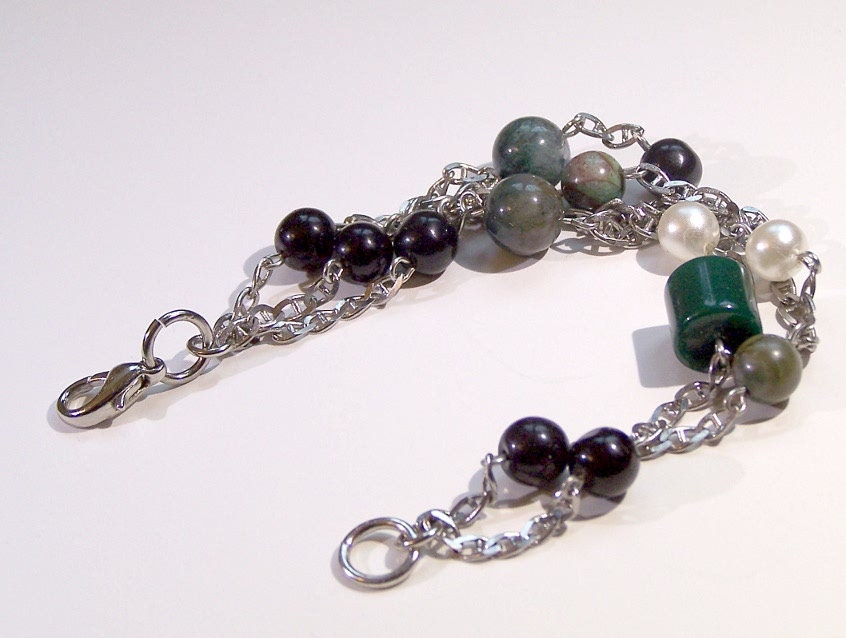
Green Full Adder Circuit Computer Science Jewelry by Kokoba
Green Full Adder Circuit Bracelet

This is the bracelet based on Project Rae, which I finished up maybe two years ago? (My God, where does the time go?) As you may recall, Project Rae was the beaded representation of a full adder circuit, which in case you forgot, looks like this:


Here is a detailed breakdown of how the bracelet works. In the bracelet above, I opted to make all of the input values true—that is, equal to 1. This results in S and Cout being true as well. Like Project Rae and the original prototype, I opted to represent the output of each gate as well. The black plastic beads represent values of 1 and the faux pearls represent values of 0. As for the gates, the large green tubular bead is the OR gate, the larger (8mm) ocean jasper beads are the AND gates, and the smaller (6mm) fancy jasper beads are the XOR gates.

I like how the Full Adder Circuit Bracelet looks, with the draping chains and the multiple strands. It just takes a LOT of attention to detail to finish: the are the loops to wrap for each bead, then there's keeping track of which chain is attached to which bead and so on. All of that while making sure the design stays around the standard 7-inch length of a woman's bracelet. It goes without saying that the Full Adder Circuit Bracelet is one of the most difficult things I make on a semi-regular basis, so I price it accordingly.

Next up is a gold-toned necklace version, with aventurine and mookaite.

Wednesday, December 12, 2012

Full Adder Circuit Bracelet: In Detail

I had a request from a customer for a more detailed portrayal of the Full Adder Circuit Bracelet (an idea for which Rae really has the lion's share of the credit). Hopefully this image should about do it. I would like to note that, nerd as I am, I'm not so much of a hardware or electronics freak, so this is an area a bit outside the realm of my expertise. That is to say, I can only half understand circuit diagrams; the bracelet below is based on a schematic Rae sent me that she had adapted herself into a bead-friendly form. I'll need to pick Lawyer Mom's brain on it later so I can better articulate what it is that I'm doing.

geek electronics computer circuit jewelry
The Full Adder Circuit Bracelet, deconstructed*

 The bracelet, as pictured here, has had the clasp taken off so I could present a more organized, easy-to-see reference image. On the clasp end, you have the inputs: A, B, and Cin. On the opposite end, you have Cout and S. They connect to the different gates and, unlike a circuit diagram, I've shown the values between gates. When B (value of zero/off, represented by the cream-colored mookaite tube) and Cin (value of one/on, represented by the faux turquoise) input to the first XOR gate, it outputs one. And when the second XOR gate has two "on" inputs, it outputs zero/off. (These are all obviously very amateur terms; like I said, I'm not a hardware freak or an electrical engineer.)

Of course, it's hard to represent something that's flat, brittle, and broad in a medium that's curved, fluid(ish) and narrow. This is a piece whose nerdiness must needs be subtle. I dig it, though! I think the overall effect is quite stylish.


*At the time of this photographing, there was a small error; a chain had broken off at work and I reconnected it at the wrong place. It's fixed now, and all loops in all chains have been secured. :)

Thursday, October 18, 2012

Foodie Friday: Budae Jjigae

I haven't been much for blogging recently. My energy has been focused on cleaning, lamenting my imminent departure, spending quality time with friends, mailing things home, lamenting my imminent departure, figuring out where to keep my luggage for a month, and did I mention lamenting my imminent departure?

I'm having a really difficult time articulating this. I've deleted about half a dozen segues and even this one has been rather painfully eked out in two- or three-word spurts. But in a nutshell: I don't half-ass (most) things, especially relationships. I am, despite my well-honed tour guide persona, very stolidly introverted. I don't have the mental capital to be a dazzling, fabulous personality that everyone knows and enjoys. Unfortunately, being a dazzling and fabulous personality is kind of what you have to do to make friends.

Absolutely fabulous!

So the fact that I've managed to make friends—real friends—friends who would be my friends if we had gone to university or high school together—and that I now have to leave them has taken the wind right out of my sails. The prospect of having to repeat the Awkward Nerd Friendship Dance still another time bums me out. And when I'm bummed out I just don't have the time or motivation to update here.

But what about the fucking food? you ask. It says Foodie Friday. Well, that's the second thing that bums me out: the loss of delicious Korean food whose replication I have yet to perfect (or whose replication would be, for all intents and purposes, impossible).

Budae Jjigae is the perfect example of a Korean dish that I will never get to my liking outside of Korea. The ingredients are easy enough (if you have access to any decent kind of Asian market/Koreatown); it's the presentation. Cooking it at home and eating it out of my own little dolsot isn't the same as sitting on the floor at some hole-in-the-wall restaurant while everything simmers away on the distinctive large, flat metal saucer.

Anyway, budae jjigae!

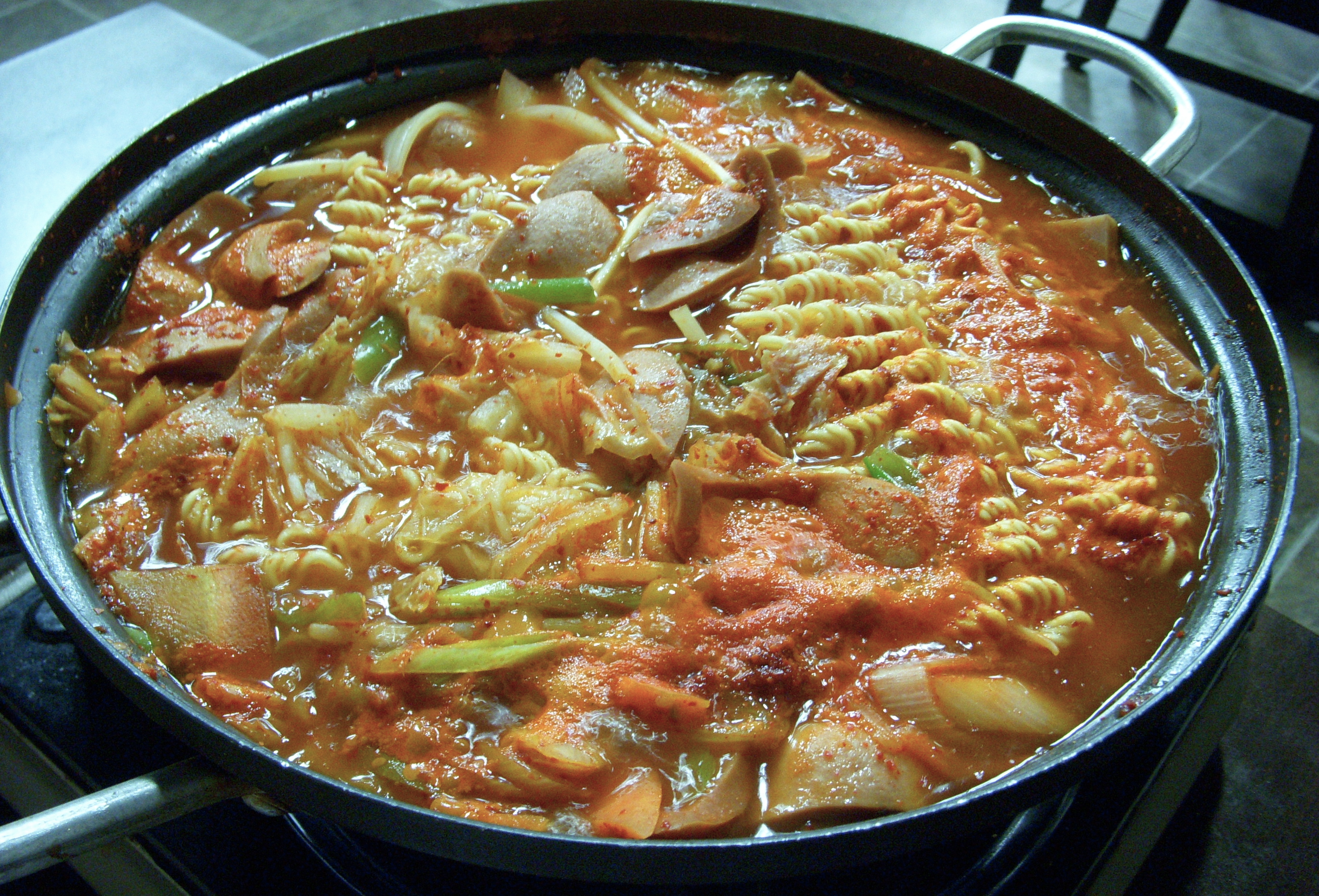
Budae Jjigae

Budae jjigae is one of a variety of jjigaes, which are best described as spicy stews. All jjigaes have a spicy red chili pepper broth, tofu,and assorted vegetables like onions, zucchini, enokitake mushrooms ("팽이버섯" in Korean), and kimchi. Variations come from what you add to the basics and are reflected in the name. You have tuna jjigae, kimchi jjigae, soybean paste jjigae, and so forth.

Budae is army, or army base. The special ingredients in budae jjigae all come from American MREs. During the Korean war, Koreans would come across MRE leftovers and, not being a wasteful people, would add them to their own food. Budae jjigae can incorporate a variety of things, but the Uijeongbu Budae Jjigae that I know and love includes only ramen noodles, sausage, hot dogs, and SPAM in addition to standard jjigae ingredients. It's one of the few dishes I categorically refuse to add cheese to because that's just not how we do it up here.

I am a big fan of Aeri's Kitchen. I like her Korean vocabulary words with each recipe, and whatever I make from her turns out delicious. Here is Aeri's Budae Jjigae recipe, if you want to make this at home.

Some notes about the recipe:

It's no great shakes if you can't find kelp or sardines for your broth. I've made plain kimchi jjigae without those plenty of times and have been thoroughly satisfied with the results. What's more important is the rice starch water (and even that's not ESSENTIAL); if you want more flavor in the broth, you can use the kimchi juice.

I'm not a fan of the cheese or beans on this one, but everyone has different tastes. This is a super flexible recipe.

Adding glass noodles is also a very popular variation; I consider them pretty essential.

Despite Aeri's recipes and my typical DIY attitude, this the only way to eat budae jjigae, as far as I'm concerned. Cooked over a hotplate in what looks like a garbage can lid:


You'll always have a place in my heart, budae jjigae.

Tuesday, September 4, 2012

MSOE Challenge: Hypatia!

The theme for the August-September challenge was "scientist," and Uli gave us a poll with too many good choices! Ultimately, Hypatia won. I've always thought she was one bad mother, so I had to make something for this challenge. And I did!

Hypatia math cuff bracelet pearl seashell jewelry
Root 2 Pearls and Seashells Cuff - Hypatia Inspired

Who was Hypatia? She was a Greek scientist, philosopher, and mathematician who lived in the third and fourth centuries of the common era in Roman Egypt. She was the last librarian of the Library of Alexandria, that fabled storehouse of knowledge lost forever to arson. Hypatia was also a world-class sassy, snarky lady:
She was so very beautiful and attractive that one of those who attended her lectures fell in love with her. He was not able to contain his desire, but he informed her of his condition. Ignorant reports say that Hypatia relieved him of his disease by music; but truth proclaims that music failed to have any effect. She brought some of her female rags[7] and threw them before him, showing him the signs of her unclean origin, and said, “You love this, O youth, and there is nothing beautiful about it.” His soul was turned away by shame and surprise at the unpleasant sight, and he was brought to his right mind. Such was Hypatia, both skillful and eloquent in words and prudent and civil in deeds.  
                                                                                                                                                    Suda On Line 

Unfortunately, Hypatia met an untimely end. In 415 C.E., aged anywhere between 45 - 65, she was murdered by a mob of rioting Christians who took her to be a godless pagan witch inciting religious turmoil. Or, as others suggest, her death was less a religious one and more the result of an ancient turf war. Either way, tragic.

Ancient Greek jewelry used a lot of metalsmithing techniques first developed in Mesopatamia and elsewhere. Metal wrist and arm cuffs were common, which is why I decided to go with a memory wire cuff. The Greeks would not have had memory wire, true, but the final look and structure of the product is similar:

Greek arm cuffs image courtesy of  Sarah Swell


A bracelet unearthed as part of the Olbia treasure
found in the Greek colony of Crimea. It dates to 100 BCE!

The beads I used are faux pearls and seashells, resembling exactly the kinds of stones the Greeks would have used in their jewelry. They also used amethyst, carnelian, and all other sorts of agates, as well as glass.

The number in this one is root 2, which is perhaps the Greekest of all the irrationals. Root 2 was discovered to be irrational by the ancient Greeks themselves, and the story goes the Greek academics wanted to keep it a secret—so much so that they reportedly killed the Greek Hippasus for revealing it to the masses!

To further celebrate Hypatia's life and deeds, I'll be settling down with the English-language Spanish-produced movie Agora this weekend. While not necessarily strictly historically accurate, it has some good reviews. 

Sunday, January 9, 2011

The Great Analytics Experiment, Part One

In an attempt to better my shop (and in the spirit of science), I'm undertaking a Google Analytics Experiment.

Hypothesis: Listing items based on top keyword results will result in more hits, lower bounce rates, more time on the site, and more pages per visit (or any combination thereof).

Step One: What are my top keyword results?

As it stands, here are the top five keyword searches (ranging from November 30th until now) that people were looking for when they found my shop:

  • pi earrings
  • golden ratio necklace
  • math jewelry
  • pi bracelet
  • golden ratio jewelry


People are clearly looking for two things here: pi jewelry and golden ratio jewelry. So, I'm going to shift the focus in my math jewelry just on the golden ratio and pi for the next round of listings. (I guess people have very little love for the square root of two, or the Feigenbaum constants. What a pity.)

Anything related to science or chemistry is curiously absent from that keyword list, but I think it's far more likely because I simply have more math items in my shop than I do science items.

Step Two: What are my stats like now?

There's lots of web traffic stats to look at. I'm going to focus on four areas, though I may whittle that down as I go along:

  • Total Visits
  • Time on Site
  • Bounce Rate
  • Pages per Visit


Total Visits is pretty obvious. So is Time on Site. Bounce Rate is how often people leave a page for somewhere else without clicking any further. It's calculated by dividing visits that lasted for only one page by the total number of visits. So, for example, if 100 people found my Etsy storefront and 60 of them continued to browse Etsy without clicking on any of my items or my profile, my store would have a bounce rate of 60%. Pages per Visit is also pretty obvious.

Why did I pick these stats?

They're all important, of course! You can't have any sales without any visits, period. So increasing Total Visits—whether repeat or new visitors—will increase your chance for a sale. And the longer those visitors are lingering in your shop, the more likely they are to buy something (and the more likely it is that they like what you do, and will consider buying in the future even if they don't on this visit). So you want the Time on Site to be pretty high, too. Likewise, if they're leaving after only one page, they probably don't like what they see all too much—so you want a low Bounce Rate as well as more Pages per Visit. My (shamefully low) stats from the same timespan, courtesy of Google Analytics, are as follows:

  • 419 Visits
  • 2.09 Pages/View
  • 65.16% Bounce Rate
  • 1:31 Average Time On Site


Step Three: Procedure

For the next month, I will focus on listing golden ratio and pi jewelry in my math section. Any new pieces I make will only be pi- or golden ratio-based. At the end of the month, I will see how the new data (from the date of the first listing until forty days after) compares.

Monday, December 27, 2010

How does this stuff work?

One of the comments I get most often online about my math jewelry is that, even if they like the piece, people "don't understand what [I] do with the numbers." This is an unfortunate reality of the nature of being primarily a digitally-based operation; when I explain the work to people in real life, it's very easy to tactilely and visually explain the math. It's much more difficult to do in text! So I whipped up a quick visual guide to my math jewelry.

The example piece is Feigenbaum's Alpha Constant, sometimes called Feigenbaum's Second Constant. It's a constant based on the relationship between tines in a bifurcation diagram. But you don't need to know that! What you need to know is the number itself: 2.502907875095892... (Note the ellipsis: both Feigenbaum constants are irrational numbers, so they never terminate or repeat but continue on into infinity.)

Because irrational numbers are a source of (literally) endless randomization, I can use as many or as few digits as I want in a piece. I truncated this bracelet early on; it only has six digits in it (which I bolded below).

math jewelry explanation
α = 2.50290787509...


And what words obfuscate, images make clear! Hopefully. If you still don't see it, think on it some more and consider these factors:

  1. I omitted the decimal point for aesthetic purposes.

  2. The beads that are crossed out with red X's are the spacer beads that separate the digits. Don't count them!

  3. You start counting at the "male" end of the toggle, with 2 in the front, and loop around until the 0 in the back.

  4. In the case of 0, I simply put two spacer beads next to each other, using a lack of beads as a placeholder the same way that 0 acts as a placeholder in the number.


Thursday, August 12, 2010

An Ode to 24

Twenty-four is my favorite number. I'm not entirely sure why that is, except that maybe it's a remnant of playing too much "24" in middle school.


If you missed out on this math game phenomenon, it's quite simple: use all of the numbers on the card once and only once to get to 24. You had a whole deck, with Easy, Medium, and Hard difficulties, and you played against others (up to four players at a go). First person to get the right answer wins the card, whoever wins the most cards wins.

There are at least three different ways of getting to 24 with this pictured card. How many can you find? Read to the end to see my answer(s)!

24 Facts
  • 24 is the only number that is the product of all the numbers less than its square root.
  • 24 divides the difference between any two prime squares greater than three.
  • Subtracting one from each of its divisors (except 1 and 2, but including itself) yields a prime number - 24 is the largest number with this property.
  • 24 is the smallest abundant factorial.
  • 24 is factorial. (4!)
  • 24 = 23 x 3.
  • 24 has a unique representation as a sum of three squares: 24 = 22 + 22 + 42.
  • 24 is the smallest number with three representations as a sum of two distinct primes: 24 = 5 + 19 = 7 + 17 = 11 + 13.
  • 24 is the largest number divisible by all numbers less than its square root.
  • 24 is 44 in base 5.

(from Number a Day and NumberGossip)

Peacock Table Numbers


What I Like About 24
  • It's divisible by both 2 and 3 (and therefore 6).
  • Also, the digits add up to 6.
  • It's a multiple of 12. (I really like number that are multiples of 12, perhaps for their utility in measurements, counting time, etc)
  • The digits are multiples/factors/square roots of each other.
  • It's a multiple of both of its digits.


Twenty-Four Elephants Cross-Stitch Chart


24 game solutions:

  1. 4(2 + 3) + 4 = 24
  2. (4/2)(3)(4) = 24
  3. (4 * 4 * 3) / 2 = 24
  4. ...


What's your favorite number?

Tuesday, July 20, 2010

Funny How That Works

It's funny how one random link on the Internet can carry you so far. Like when I saw a link to Sheril Kirshenbaum's post on Intersection about an incident in the science blogland that's unfolding as we speak.

I am investing a lot of time and thought into responding, mostly to one in particular: Preliator pro Causa. Don't ask me why that one, I couldn't tell you. Maybe because it was the first opposing viewpoint I came across in a list of responses? Don't know. Anyway, my comments there are all attributed to "Kokoba" and I listed my website as this blog, so that's how you can know it's me.

Sooner or later I will post up a distillation of my thoughts on everything that's been going on. Until then, feel free to peruse the hullabaloo and leave your thoughts here.

What's your experience on sexism in math and science? Does the incident at CommonSenseAtheism qualify as sexism? What would you think about being included on a list of "Sexy Scientists/Mathematicians"?

Friday, June 18, 2010

Whoa Nelly, rub your belly!

Wow! I got a lot of responses to Intellectual Property Talk With Lawyer Mom, more than I honestly anticipated! I am queuing up questions I've received here in comments, in Etsy convos, in the Etsy forums, and via email to tackle in IP Talk With Lawyer Mom, Round 2: Electric Boogaloo. Unfortunately, that post won't be ready until Wednesday. Today was the end of the work week for most of you, but it was just the beginning for me!

Also, here's the big fat DISCLAIMER:

Questions fielded by Lawyer Mom do NOT constitute official legal counsel. Lawyer Mom's answers are based on her experience with IP work and her interpretation and understanding of the law. Bear in mind that Lawyer Mom typically works outside the realm of (fine) arts (and crafts) and, as such, may drop the ball once in a great while. (But she is always up front about when her footing becomes unsure.)

When you submit a question for Lawyer Mom in any form—Etsy forum thread, Etsy convo, comment here, email to me, etc—you agree not to hold me or Lawyer Mom responsible for any IP-related messes you might inadvertently get yourself into. This is advice and general education here, folks. Consider Lawyer Mom a jumping-off point.

Remember, with intellectual property, it's best to err on the side of caution.


I'll probably have another update up before the next chat with Lawyer Mom, but until then, keep the questions coming!

Monday, June 14, 2010

Clap Your Hands If You Believe In Photography Fairies!

I'll come right out and say it: I hate taking pictures of my jewelry.

I don't really like popping a very "I-centered" entry in the blog so early on, but this is something that I struggle with SO MUCH in my crafty life that I felt almost obligated to share. I think other sellers on Etsy can relate (I hope so!).

I'm not "vacation photos with chopped-off heads" bad at photography, really. But something about taking very creative pictures in a very small space for a very specific purpose (showing off my work and enticing people to click on a thumbnail and then later buy it) sucks whatever photographic talent I have right out of me. I try to update my shop every day, though if I notice that I've run out of my "picture queue" I conveniently remember some other chore I have to do or errand I have to run. That's when you start seeing the gaps in the dates on the listings. ;)

Any given Etsy collection is going to be full of nothing but beautiful shots of products made with love and care, photographs that I wouldn't mind hanging on the wall as a piece of decorative art in and of themselves. It's almost enough to make me throw my hands up in despair and just give up on the whole thing. Because I know that, statistically speaking, not everyone featured up there can be a professional photographer. The people taking those pictures are people like you and me: people who didn't have the the chance to immerse themselves in the study of photography; people who have a thousand other things to do in life and a thousand hats they wear that don't have anything to do with photography.

It's also frustrating because if I think about signing up for the category showcase I cringe. "My pictures will look so bad next to everyone else's. No one will click it. It'll be a waste of money." Normally not a concern for me, but July will see Embracing Your Inner Geek Day which is, well, what I'm all about—the perfect time to hit up the geekery showcase. I'll have to decide—and soon!—whether or not I can overcome that fear of looking like a talentless hack on the internet to maybe score some sales.

I wish (as I told Etsy in the forums) that a photography fairy would come along and just drop the perfect pictures for my items right in to my hard drive. That would be so much easier, and I could spend my valuable time making new items or marketing the ones I already have. I have no qualms about what I make, in terms of the physical product; I worry that my photos give off a vibe that's more amateur than the work *really* is.

And it's not at all related to the quality or creativity of my product! My polymer charms are starting out kind of sad ("failed kindergarten projects," my mother called them) but then I immediately see what I goofed and what I can do better and there's a world of difference between the alpha release and the beta release (pictures coming soon!). But the photography—it's totally unrelated to my craft and yet it's one of the biggest things holding me back! How silly is that?!

You have to constantly strive to improve at everything you do, though—including photography! And so I continue to slog along, catching up on any articles on the Storque or anywhere else that I may have missed; experimenting with settings on my camera; reading other how-tos and tips on the internet. Progress comes in increments. I'm glad it comes at all, of course, but some days it seems almost a Sisyphean task.


What frustrates you as a seller on Etsy? Or in any creative or business venture?

Tuesday, June 1, 2010

Chemistry Charm Bracelet (Step 0)

Today I finished the first step on the way to a new line of chemistry jewelry! My Avogadro necklaces will finally have some company.

A friend of mine (PonderosaCat on Etsy, among other places) out west blogged a little while ago about the fun she had messing around with Shrinky Dinks. Some of her results are for sale: not much so far, but the Autumn Necklace she has up is darling and I love it:


PonderosaCat got me to thinking to what I could do with Shrinky Dinks. I browsed around and found out that I could use number 6 plastic (the kind in your restaurant take-out/to-go containers) just as well as Shrinky Dinks' proprietary material. Bonus: I now had an excuse to buy the chocolate chip cookies from the grocery store bakery!

This detailed, multi-part plastic doodle charm tutorial on Dabbled is a really great source, and I set out to replicate her project.

I didn't document the whole process—I don't like documenting an "alpha release" of a totally new medium for me—but I did get some promising results!


They're promising, but not perfect; Dabbled warned about colors getting darker as they baked, and so the metallic silver Sharpie I used went from a light silver sheen to a dark thundercloud gray. The squares aren't cut exactly, well, square, either, and things aren't as centered as they could be.

Despite all of that, however, I am surprised at how well this turned out. Everything I'm dissatisfied with is a result of impatience: "OMG I WANNA SEE HOW THESE TURN OUT!" The charms are as flat as I would want, and all of the little numbers in the atomic number and atomic weight printing stayed very legible. It's much more economical (and environmental) for me to wash and cut up old to-go containers than to go out to Michael's or JoAnn's every couple of days. The only change to make, besides measuring and cutting more carefully, is to nix the gray background and see what the writing looks like on plain, shrunken plastic.

This is Step 0, like I mentioned. After I perfect the art of Number 6 Plastic Charm-Making, the next step is put them on some jump rings and make some bracelets and things out of them. I want to use chain for the bracelet—instead of beads and SoftFlex/Beadalon, like I'm used to—so that will also take some experimenting.

The first compound up on the agenda is H20, followed by caffeine (C8H10N4O2), capsaicin (C18H27NO3), and ethanol (aka booze) (C2H5OH). There's a couple different directions I could go with these, and I can't wait to get more time to work out which way to go with them. But first I need to conduct more to-go container experiments. If you have any laying around, by the way, I'd be glad to take them off your hands!