Thursday, February 27, 2014

The Bogus Science of BMI


Did you know that this week is National Eating Disorders Awareness Week? It is if you're an American, at any rate.

I have been fortunate enough to maintain eating habits that are more or less free from disorder, myself, but diets and disordered eating are still topics that touch a nerve with me. While there are numerous factors that contribute to an eating disorder, I thought I'd take this space to focus on a small detail that is nonetheless integral to the public discussion of health that encourages and applauds such self-destructive behavior. It lends a tenor of scientific objectivity and medical (almost moral) authority to suggestions to lose weight; it is the sound of science without any of the actual content of science. I'm talking, of course, about BMI.

BMI is really, seriously, for realsies not a good metric of health, and here's why.


What is BMI? In case you somehow missed it.

BMI is a measurement of how much of you there is per space: your weight (in kilograms) divided by your height (in meters) squared. We all remember learning that in high school health class. If you somehow missed it in school, then there's no shortage of health journalism and medical studies that constantly cite the metric and use it as a way to sort people into convenient groups.

Yet no one ever mentions where and why this metric came to be. It sounds scientific enough, after all!


Why do we even use it?

While people had been writing and theorizing about health risks associated with being fat since the late 1700s, the first epidemiological studies on the topic (specifically, between fatness and cardiovascular disease) didn't really appear until the middle of the 20th century. Health insurance companies jumped on that data and began to cast about for a way to figure out which of their customers were more likely to drop dead of a heart attack. This economic concern over people's bodies really started in earnest after WWII, though there was no one agreed-upon method. Insurance companies basically made up body weight/height tables on a whim, with little (if any) hard data backing them up. It would take twenty years for the industry to settle on a preferred, somewhat validated method: the Quételet Index.


The Quételet Index? What?


Adolphe Quételet, the father of the Body Mass Index. His formula was never intended to be a health metric; just a statistical one.

About a hundred years prior to these insurance salesmen and worries about cardiovascular disease, a Belgian Renaissance man named Adolphe Quételet was obsessed with statistics, the Gaussian distribution, and the "normal" human body. He started off by measuring the heights and weights of infants and children, then expanded his studies to adults: a few hundred contemporary Belgians, to be precise. (Quételet may have even cherry-picked the samples and only measured the people he felt had the best or most pleasing figures—I've read this in a few places, but I was unable to substantiate it for this post.) His numerous studies and essays were collected in a volume entitled Treatise on Man and the development of his aptitudes. Included in this volume was his estimation of the best way to predict average weight: weight in kilos divided by height in meters squared. (Sound familiar?)

Quételet was gifted in many ways, but he was not a medical expert. Nor was he seeking to make medical prescriptions; he was only after an average, a way to describe the ratio between the rate of growth of height and weight and the "normal" figure.

Yet somehow insurance salesmen got a hold of the Treatise and lighted upon the Quételet Index (rebranded by a physiology professor and obesity researcher named Ancel Keys as "Body Mass Index" in 1972) as the preferred method of people-sorting. In some detail: Keys' study took the properly calculated body fat percentages from men across five countries, as well as their weights and heights. He then used a variety of "fat calculating" formulas and height-weight tables to see which ones would come closest to matching actual body fat distribution across the populations—to be fair, in this regard, BMI performed the best. But it doesn't take much to be the best out of a bunch of crap. From insurance companies the practice trickled down to scientists and healthcare professionals, until BMI became the ubiquitous statistic it is today.

To reiterate: BMI is a statistical tool used to describe the bodies of people who lived in Europe 150 years ago, popularized in the 1970s by health insurance companies as a means of prescription and diagnosis, despite the protests of professional epidemiologists, including Keys himself.

 Yet here we are in 2014 with official government health websites, scientific studies, and diet programs all using the statistic as if it means something—even as streams of stories and studies maintain that BMI is nothing but a mathematical artifact and basically useless.


What are we supposed to use, then?

Your own well-being.

If you can do the things you love to do with an abundance of energy and enthusiasm, then do you really need anything more? No, really: do you?

Of course, we are forever coming up with new ways to reduce our bodies into numbers and find the best way to figure out just how much fat we have. But in the interest of my stated purpose and participation in NEDA's Awareness Week, I'm not going to list them here—even if they're better science, linking to fat calculators here would just be tacky. Instead, a quick round-up of some good resources on BMI, nutrition, and body positivity:
  • The Skinny White Buddha has great, in-depth analysis on nutritional and obesity studies.
  • Atchka Fatty also doggedly researches and analyzes the medical science of fatness from time to time, which you can read over at FierceFatties.com.
  • If you are newly-recovered from, or still struggling with, disordered eating, Dr. Deah's nutritionist blog is worth your time.
  • So is Dr. Linda Bacon's book.
  • Any of the links I've provided in the body of this text are interesting, and were the bulk of my sources when writing this post.

In summation: just because something sounds science-y doesn't mean that it is. Don't let numbers and buzzwords fool you, and don't feel beholden to them.

Wednesday, February 26, 2014

What I'm Reading: Harpo Speaks!

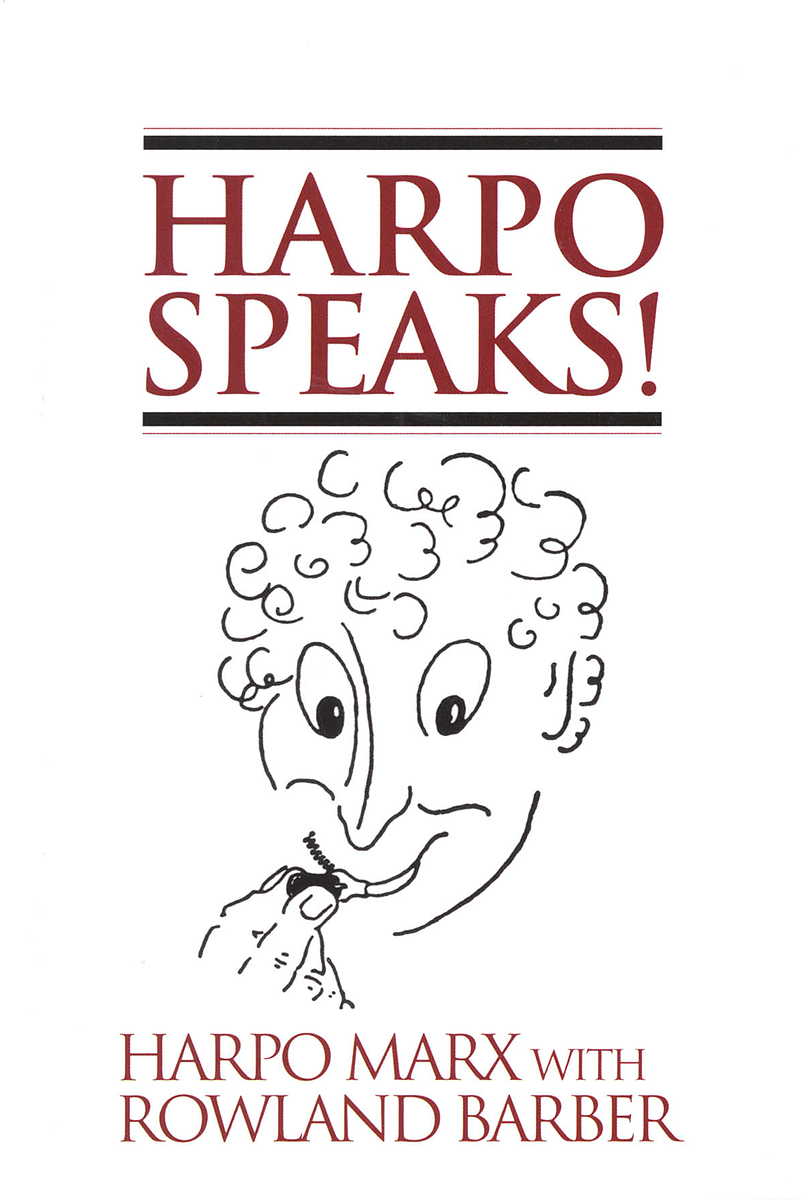
Harpo Speaks! Harpo Marx with Rowland Barber


The summer before my junior year of high school was an important period of time for many reasons, not least of which being my first Marx Brothers movie.

My best friend and I were sharing a room on a family vacation to The Outer Banks and, since we couldn't sleep, we channel surfed. When we came to a late night AMC presentation of Animal Crackers, there was something magical and delightful and just plain insane about it that compelled us to sit and watch the whole thing. From that moment on, I was hooked. 


Fast forward ten and change years later: I'm visiting NYC to see a couple of friends before I move out of the country. One friend learns I haven't ever read Harpo Speaks! and orders it for me on Amazon during lunch, as a combination early going-away/belated birthday present.

This is all to say this book is particularly special to me for a few reasons and it would be special even if it were terrible.

I'm happy to say it isn't.

Of course, it would be difficult to imagine a biography from a Marx brother that wouldn't be at least  interesting. Theirs were lives of a bygone era: of the Jewish immigrant experience in New York city at the turn of the century, of the Roaring Twenties and the Great Depression and both World Wars, of the vaudeville circuit and the reign of the theater in the entertainment world. But brother Harpo (with some assistance from Rowland Barber, though how much I have no idea) has a keen memory and a knack for spinning a yarn. His good nature and good humor shine through almost every anecdote. I am fond of this one in particular, which takes place after a triumphant tour in England. The brothers have returned to America and had a falling-out with their producer, leaving them unable to book their by-now highly successful, famous act in any but remote, two-bit theaters.

While waiting and hoping, I went for an aimless walk in the outskirts of Indianapolis. I was depressed, and confused, and I had to be alone. I kept telling myself that something good always happened every time I hit bottom. But I didn't believe it. What could happen? What could I do? Groucho could go back in vaudeville as a single. Zeppo could go back to Chicago with Minnie, where he'd have no trouble finding a job. He was the only high-school graduate in the family. Chico could land a job as a piano player, on his own terms, anywhere. 
But me? What was I trained to do besides being a Marx Brother? Well, I could play the harp on a New York City ferryboat, for nickels and dimes. Beyond that, nothing.
...
It was the only time I ever felt sorry for myself. 
I came out of my daze. I was startled to find I was standing watching an auction sale. The inventory of a little general store in the suburbs—groceries, notions and dry goods—was being auctioned off. There were about twenty people there. They must have been jobbers, mostly, because the auctioneer was knocking down the stock in big lots. I was careful to keep my hands in my pockets, so I could resist any crazy impulse to make a bid, and blow my entire capital of seven cents. 
The shelves were nearly emptied out and most of the crowd had left, but I still hung around, having nothing better to do with myself. Finally everything was gone except one scrub brush, the former owner, hovering in the background, the auctioneer, myself, and an elderly Italian couple. The elderly couple had been there all the time. Either they had no money or they were too timid to make a bid on anything. Whichever it was, they exchanged sad looks now that the auction was winding up. 
The auctioneer was tired. "All right," he said. "Let's get it over with and not horse around. I have left here one last desirable item. One cleansing brush in A-number-one, brand-new condition, guaranteed to give you floors so clean you can eat off them. What am I offered?" 
The old Italian guy and his wife looked at each other, searching for the key to the right thing to say. The auctioneer glared at them. "All right!" he yelled. "It's only a goddam scrub brush!" They held on to each other like they had done something wrong. 
I said, quickly, "One cent." 
The auctioneer whacked his gavel. He sighed and said, "Sold-thank-God-to-the-young-American-gentleman-for-one-cent." 
I picked up my brush and handed it to the old lady. She was as touched as if I had given her the entire contents of the store. The old man grabbed my hand and pumped it. They both grinned at me and poured out a river of Italian that I couldn't understand. "Think nothing of it," I said, and added, "Ciao, eh?"—which was the only Italian I could remember from 93rd Street. 
They thought this was pretty funny, the way I said it, and they walked away laughing. I walked away laughing too. A day that had started out like a nothing day, going nowhere except down, had turned into a something day, with a climax and a laugh for a finish. I couldn't explain it, but I hadn't felt so good in years. A lousy penny scrub brush had changed the whole complexion of life.
That is the whole book in a nutshell, and that is why I find myself compulsively reading it any chance I get. In an age when it seems like every beloved comedian and actor is hiding some terrible, predatory dark side, it's nice to spend time with one who has nothing but good cheer and humanity to offer.

It's also my secret fear that my generation will be the last to have anyone appreciate the Marx Brothers, so I do my best to signal boost whenever possible. American comedy owes so much to all of them.

Saturday, February 22, 2014

Science Saturday: Stellar, the Astrophysics Video Game

I came across this one by way of STEMinist.com: UCSC Students Design Video Game Aimed at Making Astrophysics Fun. For the link-phobic:
Kate Compton and April Grow, both students at UCSC's Center for Games and Playable Media, hope players will feel like they're "farming" in space as they cultivate star gardens. In doing so, gamers will also learn about nucleosynthesis, the process by which stars forge atoms into the elements that make up the periodic table. But Stellar, which will be soon be available on Google's Chrome Store, is first and foremost a game -- and its programmers hope the approach will help spark children's interest in science.
Players start with one star called Sol, Latin for sun, and a stash of hydrogen atoms. To keep Sol burning, players must feed it hydrogen. When their hydrogen supply runs low, players are free to zoom around the cosmos in search of space dust containing more of the element.
Compton, Grow, and Stellar: the astrophysics game.
Compton, Grow, and Stellar (Dan Coyro)
As players sprinkle these hydrogen atoms into their star, it fuses them into helium atoms. Players can harvest this helium and use it as another nutrient to feed their star. The stellar foundry can then fuse helium to create heavier atoms, like carbon. Stars can then squeeze these atoms into even heavier iron atoms.
Unfortunately "soon" is the best the article can do when it comes to naming a release date. I can't wait to try it out—stars and astronomy were among my earliest science loves.

Wednesday, February 19, 2014

What I Read: A History of Histories: Epics, Chronicles, Romances and Inquiries from Herodotus and Thucydides to the Twentieth Century

That's quite a mouthful of a title there. Appropriate for this dense, informative book.

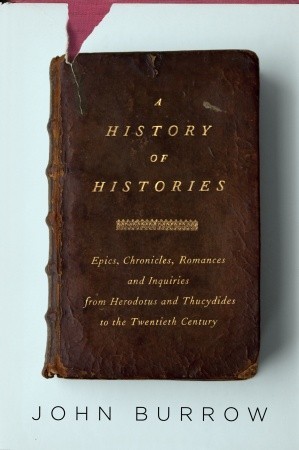
John Burrow's "A History of Histories."


John Burrow traces the practice of history-writing in the West from account-keeping in Egypt and Babylon to American and British historians of the twentieth century.

Note that caveat above: "in the West." Burrow admits right up front that he only tackles Western history, since otherwise he would be speaking (writing) out of his element. I don't blame him for that. If you've spent your entire career specializing in European history, attempting a layman's explanation of African or Asian history is not going to end well. It does make me wish for an equivalent book in those fields and on those subjects; I'll have to nose around Amazon to see what's out there.

The picture Burrow paints is not one of history as such, but rather of the people writing history. In other words, you're not going to learn all of the history you should have learned in high school (or forgot from high school) (guilty). If you want that out of the book, you should probably consult one of the many texts Burrow lists at the end of the book, which includes all of the works he discusses and many that he doesn't. They're all conveniently categorized by era and topic, so if there's a time period in particular you're curious about it's easy to find. I love books that recommend more books!

That said, in a way A History of Histories can still function as a good European history primer. Because it's about historians and historical texts, out of necessity Burrow has to take a very generalized, big picture view of trends and events. I can see how many people would find that kind of framing helpful before diving into more specific, specialized areas.

It's still heavy lifting, though. Burrow's writing, while totally lucid, is also incredibly dense and intricate, which makes skimming difficult. He was also English and (naturally) the book lingers a lot on all of the English history Americans like myself never properly learn in school (in favor of endless iterations of The Federalist Papers and The Stamp Act and The Civil War). Not a problem if you're English or familiar with English history; not even a problem if you're not, except that those sections of the book will deal with events and figures not intuitively familiar to you.

Maybe not a light-hearted beach read, but it's perfect for those of you who are still snowed in!

Monday, February 17, 2014

Music Monday: Shadowy Men on a Shadowy Planet

Odds are pretty good I've posted something by Shadowy Men on a Shadowy Planet before, but I don't care. A friend and I were just reminiscing about the Canadian "we're not a surf rock" band a few weeks ago, so I thought I'd reminisce here, too.

If you know them at all, you know them from the theme ("Having An Average Weekend") to the great Canadian sketch comedy program, Kids in the Hall. That show was a staple of my after school weekdays in high school.


.

Sunday, February 16, 2014

101 in 1001

I hope everyone enjoyed their Valentine's Day. Even if you prefer not to observe it (and I don't blame you), I hope your Friday at least was nice!

JV and I spent ours like any other day (working and studying in the apartment, watching a movie during dinner), only with more chocolate.

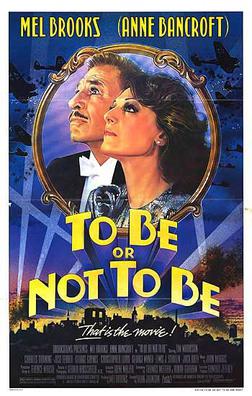
The movie selection (the above Mel Brooks' To Be or Not To Be) was a sleeper hit, as far as I'm concerned. It's not typical knee-slapping Mel Brooks fare, but it's still quite good.


In progress:

I finished reading another nonfiction book, A History of Histories. (9 - 2) It was incredibly interesting but very dense. Still, I'd recommend it for anyone interested in history and politics.

Another update and comment. (1 - 3) (7 - 3)

I whipped up a prototype necklacke design. (2 - 3) It took a couple hours but it was hardly impossible!

I watched another previously-unseen MST3K episode: Girls Town. (5 - 6)


Completed:

A History of Histories was a book I've owned for over a year, so that finishes a goal! (2 - 12) It's embarrassing how long it took me to finish it, though. Yikes.


Failed:

None!

The entire list is after the jump.

Friday, February 14, 2014

New Style Prototype: Pi Y-Style Necklace

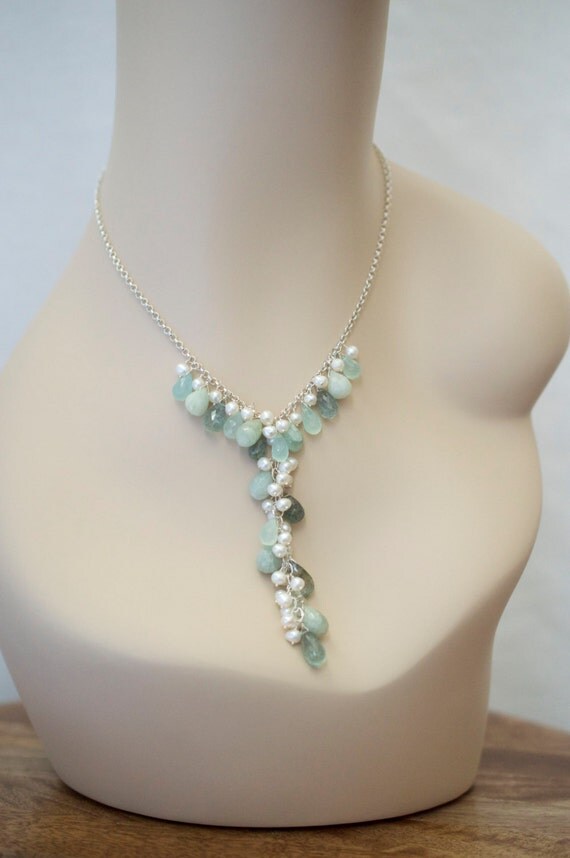
The fun thing about making treasuries for my birthstones series is that I occasionally stumble on some really inspiring jewelry. That was the case in my latest post on aquamarine; I just fell in love with the cluster-y, "dripping with gems" style of this necklace by BlueRoomGems:

Aquamarine Necklace by BlueRomGems on Etsy
Y-style necklaces are hardly new, but for some reason I had never considered them a style that would really work well with what I did until I stumbled across this. I couldn't get the idea out of my head and a couple weeks later, here we are:

math jewelry pi necklace y style
Mookaite Y-style Pi Necklace


This is just an early prototype version, made with things I had on hand. That's why you'll notice the wrapped loops are a different color (and metal) from the chain. Unfortunately, the aluminum chain I used isn't the sturdiest—it's much more decorative than structural—so a proper version available for sale will have to wait until I restock my chain stores. 

Yes, there's pi in there as well, though with some variation: from left to right, it reads 31415951413. The "9" is the dangle, around which I've placed the previous five digits according to mirror symmetry. Future designs I might opt for a more asymmetrical design that keeps 9 in the dangle, but continues on to 26535 on the right hand side. 

I love the general look of it though, and I love the mish-mash of warm mookaite colors. I can't wait to get some tougher chain in so I can make versions I feel comfortable about other people wearing.