Tuesday, September 16, 2014

September Read Play Blog: Preferred Console

Read Play Blog is a meme about video games and books, posted every 16th of the month. Bloggers are encouraged to answer a discussion question, and recommend a video game that is similar to a book they liked. Hosted by Happy Indulgence Books and Read Me Away.

What is your preferred gaming platform?

Wow, ask me to pick a favorite child, why don't you? Right now I am playing stuff almost exclusively on the PS3, though I do a bit of Minecraft on my PC from time to time. But there is a soft spot in my heart for older consoles; if I had to pick a favorite I'd have to say the Dreamcast. It was a great little system and deserved to do better than it did. Unfortunately I don't know where mine is anymore, or where the games are.

9/9/99!!

Be it Dreamcast or Wii or PS3, I am a console girl through and through. There are certainly PC games I play and like (the aforementioned Minecraft; I played Diablo 2 on PC all throughout high school; Battle for Wesnoth took over my life during university), but I like keeping a minimum of things installed on my computer at any given time. I use my computer for so much, including work, that loading it up with games seems like unnecessary stress on the system. Do I have a poor understanding of how computers work? Probably.


Currently Playing

SO MUCH DIABLO 3. With Anlouise, my level 60 lady barbarian.


The gaming community seems wicked pressed about how D3 isn't like D2 and...I don't know. No, it isn't. But Blizzard managed to capture D2's button-smashing hack 'n' slash clickfest quite well in D3, and that's what's most important. Plus they axed a lot of bullshit that annoyed me back in the D2 days, like your limited inventory or not being able to unsocket an item. There were lots of great things about D2, but that was not one of them. There was at least that hack for PC that let you have an infinite inventory (infinitory?) and redistribute your skill points (I think it was called Golden something? I want to say Golden Sun but that's something totally different), but an annoying design is still an annoying design.

I do miss the skill tree, though, It was a fun bit of strategizing. And the Horadric Cube. What, you mean now I have to pay in-game gold to an almost-racist caricature* to upgrade my gems? Weaksauce.

*Recognize that voice? It's David Lo Pan!

Thursday, September 11, 2014

Trek Thursday: The Galileo Seven

#56: The Galileo Seven


In case you forgot: A shuttle craft with Scott, McCoy, and Spock (and some other boring Enterprise crewmen) crashes on Taurus II. They try to figure how to survive and get off the planet while the Enterprise blindly gropes about for them in space. There's an obnoxious High Commissioner Ferris (Bueller? Bueller?) barking down Kirk's back the whole time.

This episode has a lot going for it, and I struggled a bit with where I should rank it. Part of the story—the stranded vessel unable to contact its blind mothership—is solid adventure/science-fiction fare. We also have some aliens for once that are neither more-or-less people nor ~beings of pure energy~: they're 10 foot tall, super primitive ape creatures. (I guess that makes them more-or-less people, but it's more of a stretch than you usually see in embodied TOS aliens.)

But it's not without its flaws, obviously. You might as well have titled this episode "Why Spock Isn't the Captain and Why Everyone on the Enterprise Deserves to Die." The former part of that title, at least, seems to be the purpose behind this episode. Unfortunately, while it's important (or at least interesting) to establish why someone as capable as Spock isn't the captain of his own ship, "The Galileo Seven" does that at the cost of making you hate everyone else and their stupidity. Since when did anyone on the Enterprise ever care about burying their dead? Why can't Spock just nerve pinch Mr. Broma to get him to shut up, already?

In the end, the bad outweighs the good, for me. There are a lot of "just okay" episodes of TOS that I don't remember well and don't mind rewatching (even if I don't enjoy rewatching them, either). But when I plowed through TOS again to write this, I definitely remembered this episode by title—and not fondly.

Tuesday, September 9, 2014

Pruning "Friday Finds" and Handmade Kokoba

I love to support fellow Etsy artisans. Whenever I find a shop I really love, you can bet it'll end up as a Friday Find sooner or later.

 But it would be naive to think that every shop on Etsy is a small, indie-operated business with just one or a handful of people. Etsy is a huge marketplace with international name recognition and there are resellers and wholesalers out there looking to bank on that name recognition to appeal to a broader audience. Etsy, of course, makes bank off of this. A small business can't list thousands of unique items at a go or handle 13,100 sales over the course of a few years—not when it's selling handmade clothing or jewelry, at any rate. But since their presence on the site benefits Etsy ($0.20 for every listing and a percentage of every sale?), they're not going away. A few, here and there, so that Etsy's reputation as a "handmade" marketplace isn't entirely laughable, but not the bulk of them. Never.

This is to say that a couple of shops that I've found and featured on Friday Finds I have, after some more detailed research (which I should have done in the beginning), decided to recant on.


I've deleted those posts from the blog and have submitted search removal requests for the URLs and search results to Google. Additionally, I will be more vigilant in future Friday Finds.

I also want to reiterate that all of the jewelry at Kokoba is handmade by me. Alone. Myself. Lawyer Mom handles most of the packaging and mailing (except the custom orders; I take care of those from bead box to post office, as it were), but I make everything. I buy my beads in small batches and, out of probably hundreds of pieces, have yet to create any identical pieces. Kokoba is not on the track to becoming mass-manufactured (well, unless I decide I want to sell some place like ThinkGeek or the IFuckingLoveScience store on my idea for a cash lump sum, but then you loyal readers would be the first to know after the ink was dry on the contracts) and you can rest assured that there is literally nothing else like a piece of Kokoba jewelry anywhere in the world.

And you can rest assured that, from now on, the Friday Finds will be better. They will be unique, indie, and handmade.

Monday, September 8, 2014

Music Monday: We Are Here

There is nothing I love more than sad lyrics paired with a cheerful melody. Except maybe sad Korean lyrics paired with a cheerful melody. (I'm a sucker for language practice, what can I say?)


Thursday, September 4, 2014

Trek Thursday: Turnabout Intruder

#57: Turnabout Intruder


In case you forgot:
The Enterprise is on a rescue mission, and one of Kirk's old flames is in the mix. Turns out the rescue mission is a ruse that Kirk's angry ex cooked up so she could use old alien technology to bodysnatch Kirk and be the captain of a starship she always wanted to be (but can't because she's a woman, and it's hard to tell if she started out unstable or if being denied her dreams and goals made her that way), while Kirk himself is stuck being....a woman. Some court martial procedural stuff happens, Kirk gets back in his own body, and justice is served.

This is one of the weirder episodes of TOS when it comes to feminism: you can easily read it as condemning the damage that happens when you needlessly limit women's roles in society. You can also read it as a condemnation of women who ~want it all~ and can't be happy with the lot of "beautiful love interest" assigned to them. Considering the source, the intended message is probably the latter, but I'll still choose to interpret it as a sci-fi statement about the importance of women's lib.

All the same, it's another bodysnatchers episode, and again it's frustrating that after all this time it's not immediately apparent to everyone that Kirk is not himself. Also, watching Shatner act out being possessed by a woman is one of the most eyeroll-inducing performances he's given.


Memorable line: "Believe me, it's better to be dead than to live alone in the body of a woman." (I feel like Roddenberry meant this in a very different manner than I'm taking it, but still, it stayed with me.)

Wednesday, September 3, 2014

First Job: Lost River Caverns

I wouldn't have remembered that Monday was Labor Day if my American friends on Facebook and elsewhere hadn't (unintentionally on their part) reminded me of it. Truth be told I'm glad to let most American holidays and observances pass me by, unremembered. But Natalie used the occasion to talk about her first job so I thought, hey, I'll do that too!

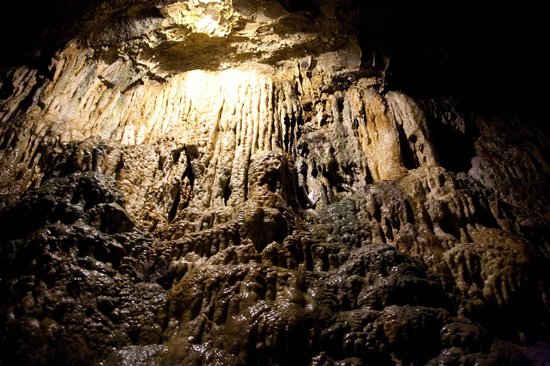
Discounting under the table work and tutoring, my first real job was one I would keep for nine (!!) years (off and on): all-purpose wage monkey at Lost River Caverns in Hellertown, PA. I have words to use, but I think some pictures would be better at setting the mood.


Art Skool Damage has a charming collection of images. For some reason I really like looking at other people's vacation photos of my old workplace!

Anyway, what you maybe can't tell from these photos is that they also are a full-blown lapidary and jewelry-making supply store. Wire, beads, drill bits, cabochons, sheet metal....if you need it to make your jewelry project, they sell it or will gladly order it for you.

I started out as a tour guide for the cave part of the attraction. Luray Caverns or Mammoth Cave it isn't—I would tell people on my tours that the cave is just a baby cave, "only" 200,000 to 300,000 years old—but it's full of beautiful formations and a fair amount of history.


Over the years I gradually took on other duties until I got a lateral promotion to the store (though I still gave tours in a pinch whenever it was necessary). For a while I was what's called in Korean army slang a zzam: someone without any official power or authority on paper, but some level of unofficial authority in practice. (Mostly by virtue of being a tour guide for a billion years and being a college grad working with kids still in high school.)

Like I said, the store is full of arcane jewelry-making stuff. But what got the most spotlight in the store, in terms of jewelry supplies and floorspace, was beads. Looking at all those beads during my downtime or while I was working on the sales floor eventually got me into making jewelry. For a year or so I just made stuff for fun: stuff I liked and wore. Then the idea for math jewelry took me by storm. Kokoba opened shop in 2008 and I've been making number jewelry ever since. In case you wanted to know how I got started, now you do!

Working at Lost River Caverns was fun. Obviously, or I wouldn't have kept coming back every summer! The pay wasn't the best (no tour guide job pays well, we appreciate tips, thanks much) but as you can hopefully see from the photos it's a surreal time warp with its own roadside America road trip charm. Many of America's privately-owned caves are, actually, and I love them all from the bottom of my heart and wish them years of success and many satisfied customers. I love their earnest insistence on being what they are and nothing else. 

The people who worked there were great, too. My bosses (the brother-sister pair who own the whole shebang) were extremely easy to work under and are interesting and knowledgeable people in their own right. Discussion fodder included Monty Python quotes and zombie apocalypse plans as often as it did concern over the spread of White Nose Syndrome or how best to set a stone in bezel mount. Fellow employees were equally offbeat and I'm still friends with many of them today. Like, not just Facebook friends—real friends. Even like a second family. It's a very self-selecting crowd who works there for any period of time; everyone has some intangible weirdness in common.

The job itself was also loads of fun. I loved helping people (most people, some customers were insufferable turdbuckets) shop for jewelry supplies and giving them suggestions or tips on bringing their ideas to fruition. I guess my middle school theater ambitions never quite died, because I also loved being a tour guide and cracking jokes and entertaining and educating people about caves, and this particular cave, and rocks, and so on. 

The best tour I've ever had, by the way&mash;as in, I've been a paying visitor to another cave—was probably at Secret Caverns in upstate New York. That's the only time I've had a guide who seemed like he was coming from the same weird mixture of nerdfun (caves are cool! science is cool!) + deep capitalist wage slave despair (I'm tired and I want to go home) + dry sense of humor I think characterized most of my tours. 

Once in a while I entertain the fantasy of living out of a Winnebago, just wandering all over the United States being a gypsy cave tour guide. Not often, but sometimes. Maybe it can be my retirement plan if Sweden doesn't pan out.

Monday, September 1, 2014

Birthstones: Opal (October)

October's child is born for woe,
And life's vicissitudes must know,
But lay an opal on her breast,
And hope will lull those woes to rest.

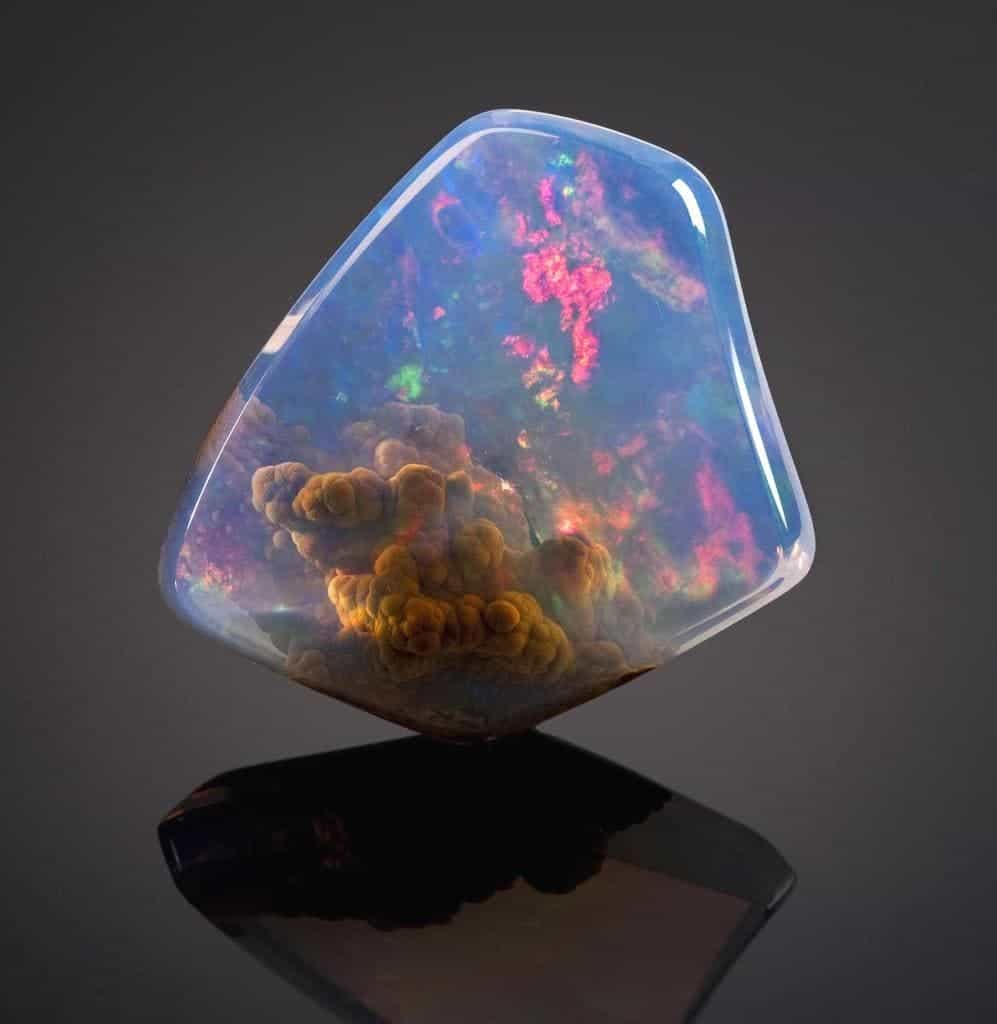
 Opal is a really fascinating gemstone, both in appearance, composition, and history. You can pick it out right away by the brilliant play of color that is the trademark of (one of) October's birthstones:


One reason that opal is particularly interesting is that it's the first birthstone in this series to not be a proper mineral.

A mineral has a uniform, organized structure throughout the entire specimen. One bit of a mineral looks largely like the next. Quartz is Si04 all the way through, ruby and sapphire are Al203 all the way through, and so on.

Opal is classed as a mineraloid—as being almost a mineral. It does have bits and pieces of regularity, but they are not found overall. Instead, an opal's crystal structure (such as it is) is akin to marbles in a vase: globs of order and structure (silicates) with bits of empty space in between. As it is hydrated, some of those gaps in between the marbles are filled with water. From 6%–10% of a given opal's weight may consist of water, though it can be as low as 3% and as high as 21%.

It is the space between that is the opal's favorite Dave Matthews Band song creates the brilliant play of color so renowned in opal. That space distorts and bends the light, resulting in a variety of different colors. You can think of an opal as an aggregate of lots of little prisms.

Microscopic silcate beads in opal.

The name "opal" likely can be traced to the Sanskrit word upala, meaning "precious stone." It comes to us today from Sanskrit to Greek (opallios, now meaning "color change") to Latin (opalus) to Middle French (opalle) to English. Because of the multitude of colors found in it, opals were thought to be comprised of many other precious gems, as Pliny the Elder wrote:

Made up of the glories of the most precious gems, to describe them is a matter of inexpressible difficulty. For there is amongst them the gentler fire of the ruby, there is the rich purple of the amethyst, there is the sea-green of the emerald, and all shining together in an indescribable union.

Opal was a popular stone among blondes, as it was thought to be a remedy against darkening hair. It was an opal ring that granted invisibility in the tale of Gyges, and thereafter in Western thought it was associated with invisibility.

Something like 97% of the world's opal supply comes from Australia, and the stone has long been treasured by Aboriginals. They associated the stone's rainbow flashes with their creator god (who originally came to Earth on a rainbow) and outcrops with opal became sacred ceremonial grounds. However, those were not the opals that Pliny the Elder was writing about; early sources in Europe often came from what is today Hungary, and then from Central America once the Age of Exploration was well underway. The world's earliest opal artifacts (dating to 4000 BCE), meanwhile, were found in Kenya, with opal from Ethiopia.

For a short while, opals were considered an unlucky stone, thanks in large part to Sir Walter Scott's 1827 novel, Anne of Geuerstein. One of the main characters, Lady Hermione, wore a beautiful opal in her hair whose color change matched her mood. After meeting some holy water, both Lady Hermione and the stone became nothing but ash.

This image lodged itself in the popular consciousness and the market for opals plummeted. This decline wasn't helped by the fact that people at the time had no idea how to properly care for opals; more than other precious stones, opal was prone to cracking and breaking, always interpreted as an ill omen.

But opal's beauty is hard to resist. With the discovery of beautiful black opals in Australia in 1877, the market revived. Shortly thereafter, Australia overtook Hungary and other European suppliers as the world leader in opal production.


I'm writing about opal in a general sense, but there are many different types of opal. There isn't any particularly type of opal that is specifically the birthstone and there isn't too much difference between types beyond coloration.

There is white opal, the most common kind of opal. At a distance, it looks more or less white (except for any color play). White opal accounts for about 60% of the world supply of opal.


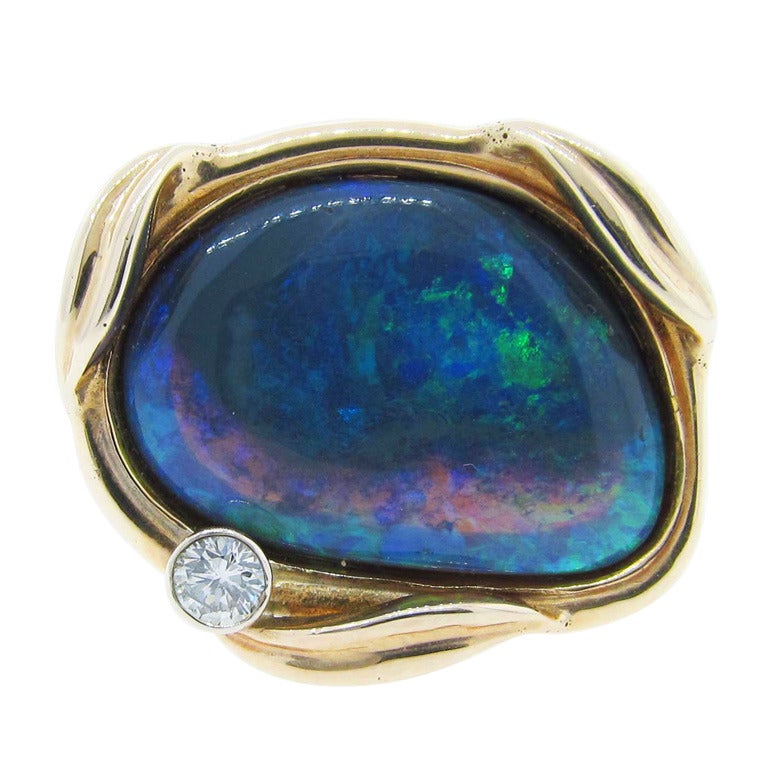
There is black opal, which looks much darker at a distance. The play of color on black opal is saturated and striking.


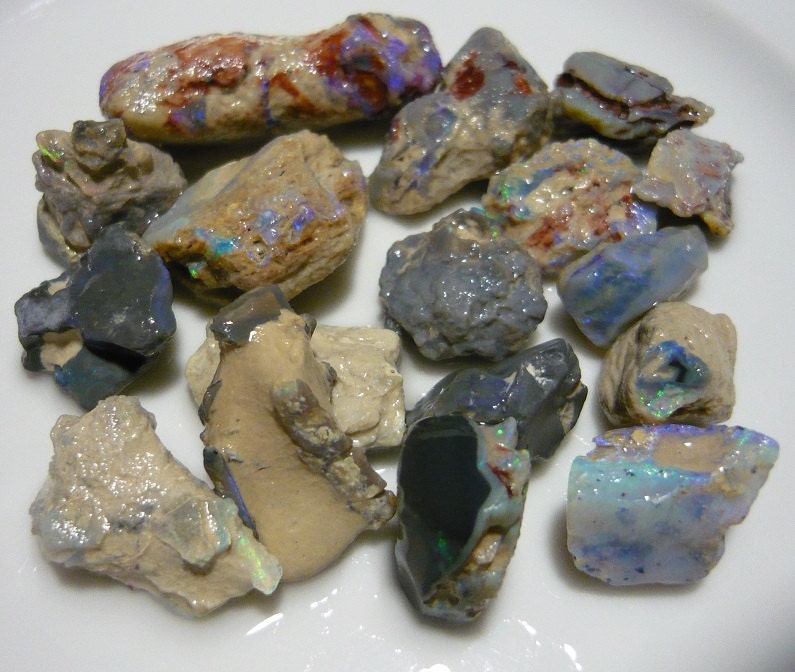
A type very similar to black opal is boulder opal. It gets its name from the ironstone boulders it forms on, and is only found in Queensland, Australia. Boulder opal on its own is quite thin, so it's always cut with a bit of the ironstone boulder left on the back; often there is also ironstone matrix throughout the whole cut stone.


If any of the first two types of opal have unusually transparent bodies, they are referred to as crystal opals.

Outside of Australia, the Mexican fire opal has become popular. Its play of color isn't as dramatic as specimens from Australia, but the colors are often fiery reds, oranges, and yellows (hence the "fire" appellation).


Any kind of opal whose play of color is more subdued and less brilliant than average is referred to as a jelly opal. An opal without any play of color at all is called common, or potch opal. Potch opal comprises 95% of the opal mined, worldwide.

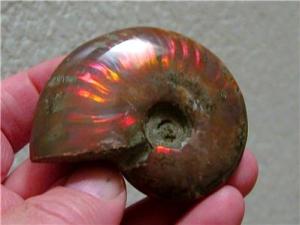
Another cool thing about opal is that it is often a replacement medium for fossils. You often find opal in petrified wood (which is to say, you often find opalized wood) and other fossilized things, including ammonites.


For some reason I never knew this until a few months ago. You learn something new every day, or something.

Because the most beautiful opals command high prices, there are of course different methods of synthesizing or imitating opal, or just reducing the cost.

If you delve at all into the online opal mines you will find people discussing doublet and triplet opals. These are slim pieces of opal epoxy'd on to a backing: sometimes potch opal, sometimes another darker, sturdy stone, sometimes black glass. This is a doublet (as in two layers, or double). A triplet is a doublet with a dome of quartz affixed to the other side of the opal—3 layers. This has long been a common way for people to create affordable, opal-like jewelry.

Opal has been synthesized since 1974, and the practice continues today, Lab-grown opals can be distinguished from natural ones by their play of color (it is much more regular and symmetrical, with larger color bands, in lab-grown than in nature). Natural opals also fluoresce, while lab-grown ones do not.

 Many, though not all, synthetic opals are more properly called imitation, as they contain ingredients not found in natural opals (plastic stabilizers, primarily). An even lower-budget imitation opal is just colored foil under glass. This was a popular choice for costume jewelry, especially during the Art Nouveau movement.

Opals also require some more care and attention than other birthstones. They benefit from lots of contact with skin, as they are hydrated mineraloids; without periodic exposure to moisture, they tend to become brittle and crack easily. They are also sensitive to sudden changes in temperature or humidity. Solid opals are not damaged by being submerged in water, but this should be avoided with doublets and triplets.

There are some misnomers out there in the world. "Opalite," for example, is not opal but is a glass imitation with similar play of color. "Sea opal" is merely sea glass. "Slocum opal" another glass imitation opal, though it less popular these days than opalite. They are all quite lovely, but intentionally marketing them as genuine opals is a pretty crappy thing to do.