Wednesday, October 15, 2014

What I Read: Grabben i graven bredvid (Benny and Shrimp)

This week's selection is not a book I would have ever picked up willingly; it was required reading for my Swedish class.


It's a romcom? Oh, ugh, I thought. But I took a closer look at the back cover and saw numerous positive reviews. "Grabben i graven bredvid kommer säkert att bli en modern klassiker." ("The Guy in the Grave Next Door is sure to be come a modern classic.") Maybe it won't be so bad, then.

False alarm. False hope, more like.

I can't imagine a situation where my fellow anglophones would ever come across this book—it came out 15 years ago and is hardly The Girl With the Dragon Tattoo (though that book is also a hot mess but that's a rant best saved for another day)—but if you do, I would advise against picking it up unless you need some mindless entertainment to pass the time. You know, like a trans-Atlantic flight or a hospital waiting room, and the battery on your Kindle is dead and so is your mp3 player and you can't sleep and you finished your Sudoku book and the only other things available to occupy your time are back issues of celebrity rags and Good Housekeeping.

I had a lot of problems with this book. I'm sure if I'd read it in English I'd only have more; I won't pretend that the literary nuance of passages here and there didn't elude me. I'm good, but I ain't that good. Nonetheless, there were other problems that were so stark I couldn't help but notice them, even through the hazy fog of my nonnative Swedish.

The story is a love story between Benny, a dairy farmer, and Desirée, a cosmopolitan Stockholm librarian. They meet in the graveyard where Desirée comes to mourn ("mourn") her late husband and where Benny tends the grave of his parents.

It's a cutesy conceit and I was willing to give it a chance, but it never picked up from there. The rest of the story is your typical mismatched odd couple love story. A chance for some great character study, not to mention commentary on class and education and what society does and doesn't value, but nope. Mazetti seems to think that so long as you insist that two characters are totally different from each other, you're spared the task of actually characterizing them.


Benny is as dull as dishwater, but I'd take him over the hysterical (and I'm using that word with all of its original sexist connotations, here) stereotype that is Desirée any day. Desirée is baby-crazy and talks endlessly about her ovaries and biological clock. Desirée and her ~BFF~ Märta (who is equally hysterical) spend their evenings drinking wine and gossiping over their men and their sex lives. Desirée is the emotional, artistic one in the relationship. And so on.

 The magical sex trope is one I'd like to see die. See, Desirée wasn't really in love with her late husband. How do we know? Why, she never enjoyed the sex. How do we know that she's not really interested in the coworker she starts seeing? The sex is mediocre. And how do we know that Benny is ~*~The One~*~ for her? Because all of a sudden she's having the best sex of her life!!!! People absolutely have different chemistry with people: two people can have really dull sex with each other but incredibly hot and immensely satisfying sex with other people. Stuff like this—"it's never been like THAT before"—is a grown-up version of the "true love's kiss" from the old fairy tales, and it's just as ridiculous.

The problem with the odd couple love story trope is that you have to have enough of a connection between these two opposites for the romance to seem plausible. Novelty wears off quickly, and if there's no rock-solid connection underneath the novelty then the relationship falls flat and, in the case of fiction, so does the story. If I can't imagine what brings these people together, then you have failed as a writer, and there is no way I can imagine or understand what Benny and Desirée like about each other or see in each other.

The best thing I can say about Benny and Shrimp is that it is a quick read, and a short one to boot.

Monday, October 13, 2014

All Food is "Real" Food


"Real food." This is a phrase I see a lot in my Internettin': on Facebook and blog posts, on Twitter, on professional ("professional") articles.

I can't stand it. First of all, unless you're having a pretend tea party with a child, all the food you're eating is real. It exists. It can be eaten. It has calories, (some) nutrients, and if you eat it you will at least keep from starving to death. (I also have a serious bone to pick with the market's decision to use "organic" to refer to a specific subset of food, but that's a rant for another day.) Some food may not be up to your standards of what is nutritious, or healthy, or whatever, but that doesn't mean it doesn't exist.

Second of all, there is a serious level of inherent snobbery in describing some foods as "real" and implying that others are fake or fraudulent. Usually the snobbery is intended to be self-directed, like, "Oh, I lost some weight after I decided to eat more real food"—implying that you think your eating habits of the past are subpar. But language like this cannot ever be only self-directed. There are always going to be people who now eat like you did. Language like this damages other people.

Third, it ignores the economic reality for many families: prepackaged foods and meals (the implied Other to the raw, unprepared, straight-from-the-plant-or-animal goods that are "real foods") are an essential staple of their survival, both in terms of sustenance as well as mental health. Preparing food is a ceaseless and often thankless task, especially when you're talking for an entire family, and assuming that low-income parents who may be working physically demanding jobs (and maybe even two or three of them!) should somehow find it in their psychic reserve to spend the rare moment of free time they have doing more work is grossly insensitive. Yes, cooking from scratch is cheaper—if you only consider the money. Cooking costs time and energy, too (that's part of the price you pay for ready-made food: the convenience) and unless you happen to enjoy cooking as a hobby, that is not time or energy well spent.

"But I'm not saying they should!" you insist. But every time you talk about how you and your family usually only eat "real food," you are inviting the comparison of someone worse off, someone whose Tuesday night savior is a can of Dinty Moore (this was the case in my house growing up) because there is no time or energy to make something "real." Judgmental language naturally invites comparison and it makes it clear on which side of the comparison your sympathy lies.

This is especially potent in parenting. There is, no doubt, an entire book to be written about the role of authenticity when it comes to raising children. A whole chapter could be spent on "real" food, and how advertising, the media, and society constantly reaffirm love is paired with authenticity and what society deems to be the best, healthiest foods, while neglect or, at best, parental inability, is paired with the inauthentic, and the lower-class "fake" foods deemed to be unhealthy or at least not sufficiently "healthy."

People have an overwhelming need for labels for everything in life, and the food they eat falls under that category: vegan, vegetarian, real food, organic food, paleo, low-carb, no-carb, and on and on. But more than any of those other labels, "real" food brings with it a nasty Other, an implied Less-Than. Don't be that asshole. Stop calling your specially-designated dietary selections "real food." It's all real food.

Friday, October 10, 2014

New Item: Black and Blue Pi Wrap Bracelet

Not a color combination I usually go for in my wardrobe, but I think the look in this one is quite dramatic!

The latest jewelry from Kokoba: black and blue wrap bracelet in twine and agate, with pi.
Black and blue wrapped pi bracelet
The dyed blue agate looks very bright here, but in typical light (and against the skin) it's more navy-colored, or even black.

Thursday, October 9, 2014

Trek Thursday: Where No Man Has Gone Before

#52: Where No Man Has Gone Before


In case you forgot: A member of the Enterprise crew catches some condition that gives him mirrored contact lenses and incredible psychic powers. Kirk tries to figure out how deal with this threat, eventually killing him. A pretty lady psychiatrist dies in the process.

This episode is the second pilot; its original airdate as the third episode must have confused the heck out of its contemporary viewers, because the differences are significant. Spock is pissy and irritable, and his dynamic with Kirk just doesn't feel right. The chief medical officer is played by the bland and forgettable Paul Fix, and the costumes are some of the ugliest sweaters ever to grace a television screen. The "person with godlike powers" trope is going to get some more mileage before the series is over, unfortunately, and this isn't really the most compelling variation on the theme. The appeal of this episode, and why it isn't rated any lower, is in its value as the second Star Trek pilot. This is what the show almost was.

Saturday, October 4, 2014

Birthstones: Topaz (November)

Who first comes to this world below
With drear November's fog and snow,
Should prize the topaz's amber hue,
Emblem of friends and lovers true.

Like most other birthstones, the topaz is a proper silicate; it's primarily made out of SiO4. It forms in igneous rocks high in silicate (pegmatites, granite, etc.). Like other tough silicates (ruby, for example), topaz is often what remains after weathering. As a result, topaz is often found in gravel and/or alluvial deposits. Significant sources include Brazil, the Ural mountains, Sri Lanka, and Burma.


What separates topaz from quartz is aluminum and fluorine that hang about in between the tetrahedrons of silicate. Its proper chemical formula is Al2SiO4(F,OH)2.
However, aluminum and fluorine don't necessarily affect the color of topaz, since it can form without colors. They instead affect the crystal lattice: topaz is orthorhombic in shape, while quartz is trigonal.

Trigonal


Orthorhombic


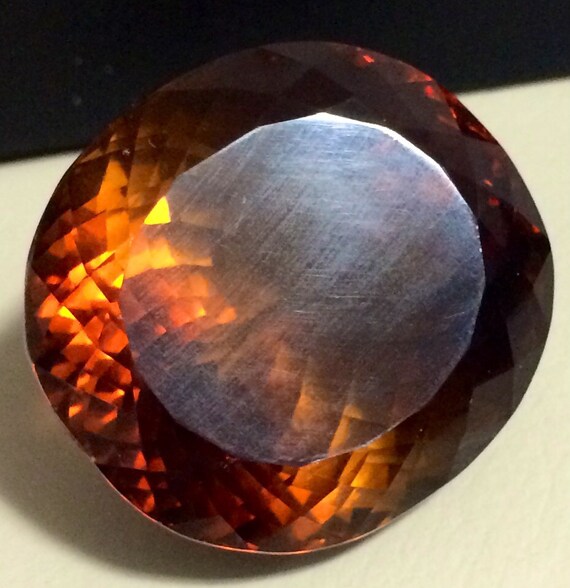
Stray chromium creates red, pink, and purple topaz; flaws in the crystal structure can lead to yellow, brown, or blue coloring. As a result of this play of light within the crystal structure, topaz is often pleochroic. There is also a whole host of trade names for topaz: imperial topaz is yellow/pink/pink-orange; blue topaz (which is rare in nature; most blue topaz has been dyed, heated, or otherwise enhanced), mystic topaz (colorless topaz given an iridescent coating), and orange topaz (orange to orange-yellow). Only the orange/orange-yellow variety are considered November's birthstone. ("Traditionally," anyway. You do you etc. etc.)

128 ct topaz from HandyNat

The name topaz is generally believed to refer to an island by the name of Τοpáziοs/Τοpáziοn in the Red Sea. Now called Zabargad/St. John's, it was an ancient site for yellow gemstones (that are now believed to have been a variety of peridot rather than true topaz) and, like many other stones, the name of their place of origin became a shorthand term for the gem itself—or any gem similar to it. Writings in the Middle Ages used the name topaz to refer to any yellow-colored stone, so it's hard to say precisely when topaz (versus olivine peridot or citrine quartz) was discovered. It isn't exactly hard to find, in any case; it's been with us for a while.

The ancient Greeks believed that topaz—and any other yellow-colored stone—imbued a person with physical strength. The Romans thought it improved eyesight, and Egyptians would wear it as a general stone of protection. Topaz was also used in Vedic astrology (some assert that the name doesn't come from the island of Topázios but the Sanskrit word "tapas," meaning fire). In addition to being associated with Jupiter, a topaz worn near the heart was thought to bestow long life, beauty, and intelligence. Europeans in the Middle Ages believed topaz could break curses and dispel anger.

Because it is relatively tough (8 on the Mohs scale), topaz can also be used as an abrasive,  but beyond that, topaz is prized first and foremost for its beauty.

Thursday, October 2, 2014

Trek Thursday: Space Seed

#53: Space Seed


In case you forgot: The Enterprise encounters an old Earth vessel from 200 years ago, with everyone aboard in suspended animation. Turns out they're all war criminals (including KHAAAAAAAN), and they take over the ship with the intent to find a planet to rule. Their plans are foiled and they are instead sent to an uncolonized planet as punishment.

Oh yeah, nerds. I'm going there. Space Seed is one of the worst Trek episodes of all time.

 My biggest grief is Marla McGivers. She sucks. When she initially refuses to help Khan take over the ship and he crushes her hand (remember, he's five times stronger than your average dude), it's just...uncomfortable. Pair that with the doe-eyed devotion Marla exhibits for him despite all that and it's too much like actual real-life abusive relationships to be able to watch.

Even if Marla is my biggest grief, she's hardly my only one. The chuckling and grudging admiration Kirk, Bones, and Scotty all have for Khan leaves another sour note over the whole episode; I come down squarely on Spock's side in this case. Imagine if someone found a cryogenically frozen Hitler and woke him up 200 years after World War II, and, after learning about the atrocities he committed, just laughed them off because he had been such a great leader of men. Then when Hitler tries to take over their starship and kill their crew, they just laugh some more and decide that rather than submit him to the justice system to which he rightfully belongs they'll just do him a favor and give him a whole freaking planet.

What the fuck, guys?

The only good thing to come out of this is Wrath of Khan, which is a near-flawless movie that may or may not have had me bawling like a small child. And for those of you complaining about continuity re: Chekov and "I never forget a face" Khan: