Thursday, May 29, 2014

ArmchairBEA Day 4: Beyond the Borders

It’s time to step outside your comfort zone, outside your borders, or outside of your own country or culture. Tell us about the books that transported you to a different world, taught you about a different culture, and/or helped you step into the shoes of someone different from you. What impacted you the most about this book? What books would you recommend to others who are ready or not ready to step over the line? In essence, let’s start the conversation about diversity and keep it going! 

Diversity is important for me. A banal statement, coming from a heterosexual cisgender white woman, but I have enough empathy to know that feeling underrepresented and invisible sucks. Not only does it suck but it reinforces all kinds of shitty "-ist" paradigms. I guess it comes out of my experience of being fat?

Back in 2009 (or maybe even longer ago), I decided to embark on the 101 Things in 1001 Days project. I think lists are a great way to push yourself to accomplishing things that are important to you; at the very least they keep you from being bored. One of the items on my first list, which is also on my second list because I didn't finish it, was to read every book on the TIME Top 100 Novels of the 20th Century list.

There are about 17 women on that list. About 9 or 10 of the writers are POC. The overlap of women and color on that list is even smaller: 3. (They are Toni Morrison, Zora Neale Hurston, and Zadie Smith. Yes, not even the late, celebrated Maya Angelou made the cut. Is I Know Why the Caged Bird Sings too autobiographical to qualify?)

At some point during the list I started to notice the Old White Dude theme and so I decided to try to mix it up a bit. Here is my altered list, which I don't think I've shared on this blog before:


1. The Adventures of Augie March, Saul Bellow
2. All the King's Men, Robert Penn Warren
3. American Pastoral, Philip Roth
4. An American Tragedy, Theodore Dreiser
5. Animal Farm, George Orwell
6. Appointment in Samarra, John O'Hara
7. Are You There God? It's Me, Margaret, Judy Blume
8. The Assistant, Bernard Malamud
9. At Swim-Two-Birds, Flann O'Brien
10. Atonement, Ian McEwan
11. Beloved, Toni Morrison

12. The Berlin Stories, Christopher Isherwood
13. The Big Sleep, Raymond Chandler
14. The Handmaid's Tale, Margaret Atwood
15. Blood Meridian, Cormac McCarthy
16. Brideshead Revisited, Evelyn Waugh
17. The Bridge of San Luis Rey, Thornton Wilder

18. Call It Sleep, Henry Roth
19. Catch-22, Joseph Heller
20. The Catcher in the Rye, J.D. Salinger


17 / 20


21. A Clockwork Orange, Anthony Burgess
22. The Confessions of Nat Turner, William Styron
23. The Corrections, Jonathan Franzen
24. The Crying of Lot 49, Thomas Pynchon
25. Cry, the Beloved Country, Alan Patton

26. The Day of the Locust, Nathanael West
27. Death Comes for the Archbishop, Willa Cather
28. A Death in the Family, James Agee

29. The Death of the Heart, Elizabeth Bowen
30. Deliverance, James Dickey
31. Dog Soldiers, Robert Stone
32. Falconer, John Cheever
33. The French Lieutenant's Woman, John Fowles
34. Martha Quest, Doris Lessing
35. Go Tell it on the Mountain, James Baldwin
36. The Gravedigger's Daughter, Joyce Carol Oates
37. The Grapes of Wrath, John Steinbeck
38. Please Look After Mother, Shin Kyung-sook
39. The Great Gatsby, F. Scott Fitzgerald
40. The Jungle, Upton Sinclair


12 / 20

41. The Heart Is A Lonely Hunter, Carson McCullers
42. Native Speaker, Lee Chang-rae
43. The Namesake, Jhumpa Lahiri

44. Housekeeping, Marilynne Robinson
45. The Poisonwood Bible, Barbara Kingsolver
46. I, Claudius, Robert Graves
47. Infinite Jest, David Foster Wallace
48. Invisible Man, Ralph Ellison
49. Light in August, William Faulkner
50. The Lion, The Witch and the Wardrobe, C.S. Lewis
51. Lolita, Vladimir Nabokov
52. Lord of the Flies, William Golding
53. The Lord of the Rings, J.R.R. Tolkien
54. Kokoro, Soseki Natsumi
55. Lucky Jim, Kingsley Amis

56. The Man Who Loved Children, Christina Stead
57. Midnight's Children, Salman Rushdie
58. Money, Martin Amis

59. The Moviegoer, Walker Percy
60. Mrs. Dalloway, Virginia Woolf

17 / 20

61. Naked Lunch, William Burroughs
62. Name of the Rose, Umberto Eco

63. Native Son, Richard Wright
64. Neuromancer, William Gibson
65. Never Let Me Go, Kazuo Ishiguro
66. 1984, George Orwell
67. On the Road, Jack Kerouac
68. One Flew Over the Cuckoo's Nest, Ken Kesey
69. The Painted Bird, Jerzy Kosinski

70. The Buddha of Suburbia, Hanif Kureishi
71. A Passage to India, E.M. Forster
72. Play It As It Lays, Joan Didion
73. Farewell to Manzanar, Jeanne Wakatsuki Houston
74. Kafka on the Shore, Haruki Murakami
75. The Prime of Miss Jean Brodie, Muriel Spark
76. Rabbit, Run, John Updike
77. Ragtime, E.L. Doctorow

78. The Power and the Glory, Graham Greene
79. Red Harvest, Dashiell Hammett
80. Revolutionary Road, Richard Yates

15 / 20

81. The Sheltering Sky, Paul Bowles
82. Slaughterhouse-Five, Kurt Vonnegut
83. Snow Crash, Neal Stephenson

84. Possession, AS Byatt
85. The Good Earth, Pearl S. Buck
86. Your Republic is Calling You, Kim Young-ha

87. The Spy Who Came in From the Cold, John le Carre
88. The Sun Also Rises, Ernest Hemingway
89. Their Eyes Were Watching God, Zora Neale Hurston
90. Things Fall Apart, Chinua Achebe
91. To Kill a Mockingbird, Harper Lee
92. Sons and Lovers, D. H. Lawrence

93. Tropic of Cancer, Henry Miller
94. Ubik, Philip K. Dick
95. Under the Net, Iris Murdoch
96. Villa Incognito, Tom Robbins
97. Watchmen, Alan Moore & Dave Gibbons

98. White Noise, Don DeLillo
99. White Teeth, Zadie Smith
100. Wide Sargasso Sea, Jean Rhys

There are 18 substitutions I've made. Two of them were just one author's book for another based on what I could find at the time, but the rest were totally new authors. Here are the books I jettisoned:

A Dance to the Music of Time
Gone With the Wind
Gravity's Rainbow
A Handful of Dust
The Heart of the Matter
Herzog
A House For Mr. Biswas
Loving
Pale Fire
Portnoy's Complaint
The Recognitions
The Sot-Weed Factor
The Sound and the Fury
The Sportswriter
To the Lighthouse
Under the Volcano


First and foremost, I decided to do away with any author repeats. The only repeat I kept was George Orwell, but even then I think before the end of this list I'll choose another book replace either Animal Farm or 1984. So that meant one book each by Saul Bellows, William Faulkner, Virginia Woolf, Philip Roth, Graham Greene, Vladimir Nabokov, Thomas Pynchon, and Evelyn Waugh got axed. I also deliberately took Gone With the Wind off the list because there is nothing more unappealing to me than the American Civil War (sorry).

How to fill those gaps? First, I chose highly-acclaimed work by (East) Asian authors, a continent I felt was poorly represented (minus India). Those books included Native Speaker, Please Look After Mother, Farewell to Manzanar, The Namesake, The Buddha of Suburbia, Kafka on the Shore, and Your Republic is Calling You. I also added books I wanted to read but hadn't yet, but were considered classics (Sons and Lovers, The Jungle), and one book I thought had been unfairly excluded (The Name of the Rose).

As my list went on, I read other books too. Once in a while I would read one that was really good, so good I was surprised it wasn't already on the list (Cry, The Beloved Country and The Good Earth spring to mind) and I would go over the list with a fine-toothed comb to figure out which title I wanted to remove for the sake of its inclusion. I guess I could have just added it to the list to make it 101 books or 102 books or so on, but I want to keep it at list of 100 books.

My new list has more, but still too few, women (24 instead of 17), writers of color (15 instead of 10), and women of color (6 instead of 3), and there are still huge gaps when it comes to other issues, but it's a start.

I go through all of this work and deliberately search for stories about and by people who aren't Old White Dudes because the stories we repeat and tell ourselves are important. It creates the bulk of the social reality around us. Physical reality things, like gravity and evolution, can't be manipulated or distorted—there is literally no escaping gravity, and natural selection goes on every day—but social reality things like stereotypes, social norms, and gender roles are malleable and can be altered. A large part of that alteration comes from being exposed to new stories, and new kinds of stories, and often. There is a hidden, truthful reality about race and gender and whatever else, but first we need to undo the stereotypes and preconceptions that prevents us from accepting them. I keep linking to this but it's still relevant: We Have Always Fought: Challenging the Women, Cattle and Slaves Narrative. This article only focuses on the representation of women but it works for just about any marginalized group.

The stories we tell create our paradigms. That has been made painfully apparent this past week. To insist otherwise is naive, and that's why diversity in fiction and media matters.

Wednesday, May 28, 2014

ArmchairBEA Day 3: Expanding Blogging Horizons and Novellas/Short Stories

First, I want to say that I had SO MUCH FUN at the #ArmchairBEA Twitter party yesterday (last night for me, hah). I usually use Twitter as a series of public Post-it notes, like: "This quote is funny!" or "I just wrote a blog entry!" or "Check out this link!". #ArmchairBEA is my first experience with using Twitter as a realtime conversation tool. It got off to a slow start but then we started talking about the finesse of GoodReads reviews (a 3-star review isn't a bad review) and overhyped books and it was like I had found my people.


Second, I want to say that I picked a great week to have a leg injury. If I can't be out and about too much, then at least I have something to blog about while I'm sitting at home.

(I broke my butt doing yoga—no joke. It's recovering, but slowly, because it's hard to rest, compress, and elevate your butt.)

What do you think about when you think about going beyond blogging or expanding your horizons? Is it a redesign of your blog? Have you branched out into freelance writing or even published a novel of your very own? Or, have you moved into a different venue like podcasts or vlogging? This is the day to tell us about how you have expanded on blogging in your own unique way. 

To be honest I don't think of myself as a ~blogger~ because I do it primarily for fun and secondarily as a way to build my jewelry brand. (For those of you who are finding me through #ArmchairBEA: yes, I make jewelry, math jewelry even, but I love books so much I can't NOT blog about them.)

The thing I'd like to do most is redesign the site, and even then not by very much. Maybe switch up the photos in my banner up top (or more accurately, have JV switch them up), and, more importantly, get a slicker, "not-so-obviously-from-Blogger" layout going. But then, to be honest, I read most of my blogs through a reader (first Google reader, then The Old Reader, now Inoreader), so you could have the most beautiful website in the world and it wouldn't make much difference to me anyway. so it's not like I know or care if any of them have very basic layouts.

I am not a big podcast fan—like with audiobooks that I mentioned in yesterday's post, I space out and don't follow the conversation/monologue, no matter what. Right now I'm listening to The History of Rome but I have to set aside time for that, and sit with a notebook and pen to take notes. So why would I start blogging in a format I hate?

Vlogging has the same problems for me as podcasts. The videos I watch tend to be more webseries than actual vlogs, and I might as well take the time now to note a couple I regularly enjoy.

MinutePhysics by Henry Reich is a series of great, well-explained animated answers to sometimes-tough science questions. If there's ever a science question that's had you puzzled, check the archive of videos. Maybe Reich's tackled it already!

Vi Hart has a similar channel with math doodles, though it's mostly focused on pure mathematics (and other things, like net neutrality and 12-tone series). I love the dry sense of humor she uses in every video.

The Tabletop series from Geek and Sundry is a fun way to discover new board games, in addition to just being entertaining to watch.


Now it is time to give a little love to those little stories in your life. Share your love for your favorite shorts of any form. What is a short story or novella that doesn't get the attention that it deserves? Recommend to readers what shorts you would recommend they start with. How about listing some short story anthologies based upon genres or authors? 

I typically don't read shorter pieces. I think that's because, as a writer, I always struggled with keeping my short stories short. Brevity is not my strong suit! Likewise, I like to read things that are like what I (sometimes attempt to) write: full-length novels.

 Of my own free will I've read maybe one anthology of short fiction in my life (Year's Best SF 16 or something like that), and a handful of Sherlock Holmes stories. Most of the short fiction I've read has been for school, and so the results are hit and miss. Ilse Aichinger's "The Bound Man" is a hit. So is "Children on Their Birthdays," or maybe I just liked it because Truman Capote was an author I actually had heard of. I at least remember Jorge Luis Borges' "The Aleph," though I couldn't say how much I actually liked it. I also had to read a lot from Peter Meinke's Unheard Music collection, but none of them really stood out as shining examples of the genre. Needless to say, my copies of The Art of the Tale, The Art of the Story, and Best American Fiction 2007 stayed in my library after college. Unheard Music did not.

If I stretch all the way back to eighth grade, there's also "Star Food," by Ethan Canin, from his collection, Emperor of the Air.

The one and only anthology of short stories I've really loved and enjoyed, in totality, is the Flight series. Tying in to yesterday's collection, it is a graphic novel collection. Or rather, a graphic short story collection. If you haven't read a Flight anthology, you're missing out.

Edit: I totally lied! I forgot to mention Philip K. Dick! Shame on me, I even wrote on Do Androids Dream of Electric Sheep? for my senior philosophy thesis. But his short stories are masterpieces. I've been meaning to re-read "Minority Report" and "Paycheck" for a while, now. They are excellent stories. The movies.....questionable.


What's your favorite short fiction anthology?

Tuesday, May 27, 2014

ArmchairBEA, Day 2: Author Interaction and More Than Just Words

Let’s talk interacting with authors IRL (in real life) or online. This is your opportunity to talk about your favorite author readings that you have attended. Or, you can feature your favorite author fan moment (i.e., an author sent you a tweet or commented on your blog). Maybe you even want to share how your interactions have changed since becoming a blogger or share your own tips that you have learned along the way when interacting with authors as a blogger. 

I guess because most of my favorite authors are dead, I haven't interacted much with any writers or been to any readings. I'm not really in touch with the book trends these days (allow me to rock in my rocking chair and wave my shotgun around threateningly at all the kids on my damn lawn) so actually engaging with authors is totally alien to me.

I attended a panel with George R. R. Martin when I went to Vericon, which would have been cool if I actually liked the A Song of Fire and Ice series. I also follow Grant Morrison, William Gibson, and Warren Ellis on Twitter but I don't really try to interact with them.

I'm just a really boring person, I guess!


There are so many mediums that feature more than just words and enhance a story in a multitude of ways. Examples may include graphic novels and comics, audiobooks, or even multimedia novels. On this day, we will be talking about those books and formats that move beyond just the words and use other ways to experience a story. Which books stand out to you in these different formats? 

The format everyone is talking about for this question is graphic novels. I'm a fan, and I've been leaving recommendations on other blog posts, but I figure I might round them up in one place!

The first kind of graphic novels I really like are the superhero deconstruction ones. "Red Son" by Mark Millar takes the great American hero, Superman, and posits an alternative universe where he landed in the Soviet Union. I generally think Superman is the single most boring hero in the genre, but a spin like this is really interesting. Plus there are cameos from Soviet Batman and Soviet Wonder Woman! Grant Morrison's little 5-issue "Supergod" also falls into this category.

The other two superhero genres I like are less deconstruction and more just general "pomo" superheroes, a bit grittier and more realistic. The first is Grant Morrison's run on "Doom Patrol," though it kind of peters out towards the end. The first two volumes are great and once I have more shelf space and a million dollars I'll have copies of my very own. The second is Brian K. Vaughan's "Ex Machina." I never got to finish the series, but I love the premise (guy gets cool tech-related superpowers from some weird artifact in the Hudson, does the superhero thing for a while and then becomes mayor of NYC). Hopefully one day I'll be able to read the whole thing!

The other kind of graphic novel I like is much more like a visual art project. The "Kabuki" series from David Mack starts out as a rather straightforward cyberpunkish thriller ("Circle of Blood), but later collections move from simple black-and-white ink drawings to glossy full-color mixed media collages ("The Alchemy").


Mystery Play also plays a lot with art form, though not to the extent that "Kabuki: The Alchemy" does. But the blurry water colors do a lot to reinforce the surreal, dream-like nature of the story.  Do you know of any other graphic novels with art like this?


Promethea is a kind of combination of the two: she is a sort of ceremonial/chaos magic superheroine, but the story goes to some truly unique and trippy places. I'll take this piece of the Alan Moore oeuvre over Watchmen or V for Vendetta any day. 


While Train Man only uses the regular written word, I feel it deserves a mention here because it uses an entirely new novel format: the story is told exclusively through a series of Internet messageboard posts. Posts that actually existed on 2chan and that you can go and read online for yourself (if you can read Japanese). Who knows how much of it's actually true and how much of it is one sad guy posting a lengthy fiction on 2chan to entertain himself and others, but it's the format I find intriguing. It's like a 21st century epistolary novel.

Audiobooks will never be for me; I get frustrated with how slowly people speak compared to how quickly I can process the words on my own. If I put something like a video lecture or a podcast on in the background I can 100% guarantee that I will space out and not absorb anything unless I sit and take notes. I much prefer music for my background noise. 


Special shout-out also goes to Agrippa: A Book of the Dead, which I could never get my hands on when it came out, and which is now useless to have since the text comes on a now-antiquated 3.5" floppy disk. Nonetheless, I still think the concept was a genius one and hope to see something like it again in the future.

Monday, May 26, 2014

Armchair BEA: Introduction

The #ArmchairBEA (Armchair Book Expo America) is slated to being, uh, today? Maybe? I'm going to (try to) participate over on Twitter (as best I can in my GMT +1 time zone). Here are the introductory questions, if you'd like to be polite and introduce yourself, and here is party HQ. Use the hashtag #ArmchairBEA on Twitter to join the conversation!


Please tell us a little bit about yourself: Who are you? How long have you been blogging? Why did you get into blogging? Where in the world are you blogging from? 

Hello! I am a twenty-something American expat in Stockholm. Normally this is where I blog about (feminism and women in) STEM and my jewelry, but I also am an avid reader and so stuff about books finds its way here, too. I've been keeping this blog since 2010 but I've been blogging online in one form or another since 2003. I've got, like, opinions, maaaaaaaaan, and I have to express them somewhere!


What genre do you read the most? I love to read because ___________________ . 

It changes depending on my goals and mood. SF/F is a genre that I'm always willing to tackle, though I am very picky about it. Right after college I went on a pop nonfiction binge because I had read basically nothing but either heavy-duty philosophy texts or the canon works of Western literature for my English (Creative Writing) and Philosophy degrees and my analytic, critical mind just needed a bit of a break. At the moment I'm trying to read all of the books on TIME magazine's "Top 100 Novels of the Twentieth Century" list, with alterations here and there, so right now I'm reading a lot of "literary fiction." Which ties in nicely with the first blog topic!

What do you think of when you think of literature? Classics, contemporary, genre, or something else entirely? We are leaving this one up to you to come up with and share the literature that you want to chat about the most. Feel free to share a list of your favorites, break down your favorite genre, feature your favorite authors, and be creative about all things literature in general. 

For me and my English degree, literature is all that great stuff in the canon, plus the stuff that women, people of color, and other marginalized people may have been writing at the same time as the dead famous white guys. It's writing that is it at once easy and addictive and compelling to read but also difficult, requiring lots of thought and rereads. It speaks to issues that are both timely and universal.

My goal after the TIME Top 100 list is to crack some literature outside of English, in Swedish and French (two languages I can read fairly well) and translated to English otherwise. My favorite discovery in this quest so far is Kokoro, by Natsume Soseki. Do you have any other nonanglophone books to recommend? Please do so in the comments—I'm always looking for new reads!

The other thing I'm always looking for is a fresh take on the novel form and different ways of storytelling. I didn't care much for the story of Train Man—even though it is purportedly a true story about an Internet message board helping one timid user on his quest for love, it does become so Hollywood that you have to wonder who is lying, about what, and how much—but the idea of a bunch of disparate posts on the Internet coming together to be a story as a 21st century epistolary novel is really cool. I hope that's a format that catches on in the world of "professional fiction."

Maybe I ought to write that novel. Hum.

I love to read because I love being challenged and educated. Entertainment is nice, too, but I like it when a book goes above and beyond that. I like learning about how the world works, or about how people who are different from me experience the world.


What was your favorite book read last year? What’s your favorite book so far this year? 

I read some good books last year: The Bridge of San Luis Rey, Death Comes For the ArchbishopBeloved, and A Confederacy of Dunces all stand out as excellent, thoughtful novels I'd like to add to my permanent collection. In terms of more recent books, the only new release I read this year was Crown of Midnight, the second book in the very fun, very dramatic Throne of Glass series.


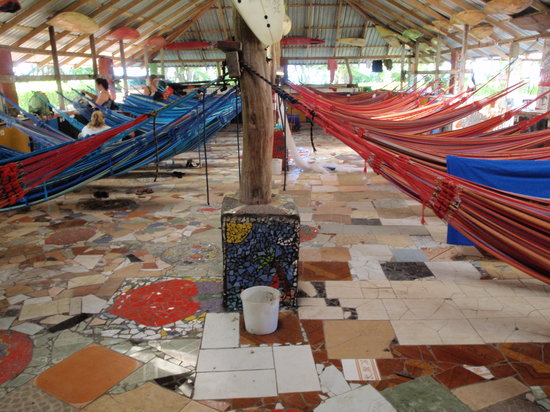
What does your favorite/ideal reading space look like? (Pinterest encouraged!) 


This is Rockin' J's hostel in Puerto Viejo. I spent a few nights here when I was in Costa Rica and there is nothing better than snuggling in one of their hammocks and reading while you listen to the rain on the roof. This is where I read the bulk of Infinite Jest, in one of the hammocks on the left.


Share your favorite book or reading related quote. 

There are so many, but I think I'll choose one from Walden, from the chapter called "Reading." It stuck with me the first time I ever read it and it still resonates with me now, and I think it's a good quote to leave off with:

However much we may admire the orator's occasional bursts of eloquence, the noblest written words are commonly as far behind or above the fleeting spoken language as the firmament with its stars is behind the clouds. There are the stars, and they who can may read them. The astronomers forever comment on and observe them. They are not exhalations like our daily colloquies and vaporous breath. What is called eloquence in the forum is commonly found to be rhetoric in the study. The orator yields to the inspiration of a transient occasion, and speaks to the mob before him, to those who can hear him; but the writer, whose more equable life is his occasion, and who would be distracted by the event and the crowd which inspire the orator, speaks to the intellect and health of mankind, to all in any age who can understand him.
Nice to meet you all!

Saturday, May 24, 2014

Beaded "Chan Luu" Wrap Bracelet: Second Experiment (Hemp)

Whenever I discover a new technique, I can get kind of obsessed. After my first Chan Luu bracelet attempt went so well I decided to try another. 

Unfortunately, I couldn't find the last of the leather I bought. I do, however, have a whole lot of hemp (for another style I'm working on, but more on that another time). Even though all the bracelet styles I had seen earlier had used leather or faux leather, why wouldn't hemp work? I couldn't think of a reason, so I sat down and made one.

A Chan Luu inspired wrap bracelet with red creek jasper, hemp, and pi.


A Chan Luu inspired wrap bracelet with red creek jasper, hemp, and pi.

Fortunately this hemp is nice and soft, not rough and itchy, so it's very comfortable to wear. As you can infer from the photos, the hemp also has a little less structural integrity than the leather, so it drapes and bends much easier. After wearing both, I do think I prefer the hemp one, but everyone has different tastes. 

I'm also a lot happier with how the hemp one came out aesthetically: no goofs in the beadweaving, and no weird distortions due to the two different bead sizes.

Oh, I almost forgot! Of course this is a pi bracelet. Pi is spelled out in the red creek jasper beads; the white generic stone ones are the spacers. 

Thursday, May 22, 2014

Trek Thursday: The Apple

#65. The Apple


In case you forgot: The Power Trio plus a few redshirts are investigating an unknown planet. After Spock gets sick and a few redshirts eat it, they learn the planet is run by a giant computer fed by the spray-tanned inhabitants of the planet, who never age or have sex. Kirk and company destroy the computer to save the Enterprise and to teach the inhabitants how to get freaky.

Welcome to a theme you're going to see a lot on this list: "computer running society to disastrous results." The Apple is the worst of it, because you have to wonder if The Enterprise ultimately brought more net good or net evil into the galaxy. Other computer-run societies in we see in Star Trek:TOS do legitimately kind of suck, for one reason or another. Vaal (the binary beast in question), by comparison, is benevolent (aside from a bizarre, Puritanical aversion to sex), and everyone who lives on Gamma Trianguli VI seems to have a good run of it. Okay, so Vaal has fucked with The Enterprise somehow and so must be destroyed to save the crew of 430-odd souls, but the moral question of the episode hinges around whether or not destroying Vaal is good for the planet's residents.

(Wait, I'm suddenly reminded of the TNG episode Justice....)

Maybe it was intended to be one of those stories that was bittersweet, or at least morally ambiguous, but I don't think so—the series is very fond of preaching the wonders of self-determination and independence, and whatever solution celebrates these qualities the most is invariably The Right Thing To Do (episodes where Kirk risks the crew to save a landing party of a dozen or so excluded). Sure, they don't have a hedonistic (though virgin) paradise anymore, but the people now have social progress! And sex!

There's not much of a story, or at least not one that can fill 50 minutes without padding. This episode, they up the ante by making Spock sick, killing a couple redshirts, and leaving Kirk to wonder if he's really fit for this starship captain business. Which would be an interesting conceit on its own, and actually deserves its own story. Not a perfunctory five or ten minutes in an episode that can't stand on its own legs.

The A.V. Club also took on every Star Trek: TOS  episode, and noted that it would have been a cool story conceit if once in a while the Enterprise just came across some weird, fucked-up shit in the galaxy they couldn't understand or fix, and just peaced out. I agree, because that's probably want intragalactic (and intergalactic, for that matter) space travel would be like: "Well, it looks like some more weird shit that isn't exactly hostile but that we can't explain, captain." Props to Stanislaw Lem for doing exactly that. But Star Trek isn't about making that kind of weirdo, postmodern statement about the true nature of space travel, so when it doesn't give a proper history or background of any of its peoples or even monsters (or as proper as one can expect if we're operating under situations of extreme duress), it's deeply unsatisfying, Who built Vaal? How do his people seem to stay young and vital presumably into perpetuity? How does Vaal even work? Why hasn't anyone ever thought to bump uglies? If the episode had focused more on these questions as filler, instead of dead redshirts and a suddenly-insecure Kirk, it might have been passable.